Available space
Determines the gauge, train length, layout shape and required access.

From the first idea to reliable operation
A reliable model railway is created through several coordinated decisions. Choosing the available space, scale, track system, power supply and control system in the correct order prevents expensive system changes and planning mistakes that are difficult to correct.
This guide takes you from the initial space and budget assessment through gauge and system selection to the first train, track plan, test operation and scenery. It also explains when a starter set is the better choice and when individual components offer greater flexibility.
The most important basics on one page
A functional railway depends on several coordinated decisions. Following the correct sequence helps avoid costly system changes and planning errors that are difficult to correct later.
The available space comes first. It determines which model railway gauge , train length and layout format are practical. The track system, current pickup and control system are selected next. Locomotives, coaches, wagons and technical extensions should only be chosen on this basis.
The first operating railway requires a locomotive, matching coaches or wagons, a complete or usable track route, a power supply and a controller. A starter set combines these components in a coordinated package. Anyone who has already chosen a specific prototype or track system can instead begin with individual components.
Scenery is deliberately added later. First, all vehicles must travel reliably at low and high speed, when pulled and pushed, and in both directions over points and rail joints. The track can then be fixed and ballasted before buildings, roads, vegetation and figures are added.
Divide the budget into three areas: operation, expansion and scenery. This leaves sufficient room for points, connecting materials, tools, cleaning products and later landscape construction in addition to the train and controller.
Determines the gauge, train length, layout shape and required access.
Defines the track geometry, conductor system and current pickup.
Analogue or digital operation must suit the locomotives and planned functions.
Reliable operation must be established before permanent scenic construction.
Do not ballast any track or close a tunnel until every intended vehicle can travel reliably through that section.
From the first idea to an operational train
This sequence combines space planning, technology, operation and scenery. Every step provides the foundation for the next decision.
Starting point and objective
Measure the length, width and accessible depth. Consider doors, furniture, radiators, sloping ceilings, transport routes and storage. Decide whether the railway will be permanent, mobile or seasonal.
Size of the model world
Smaller gauges permit longer routes, while larger models are easier to handle and show more detail. The available space, desired train length and safe handling are decisive.
Technical foundation
In H0 in particular, two-rail and centre-conductor systems must be distinguished. Current pickup, wheelsets and all later vehicle purchases must match this decision.
Operating concept
Analogue control is easy to understand for one train. Digital control permits several independently controlled locomotives, lights, sound and additional functions on the same track.
First vehicle collection
Starter sets simplify a coordinated beginning. Individual components provide more freedom but require an exact check of gauge, track, conductor system and digital protocol.
Route design
Plan radii, points, usable track lengths and access. For a first layout, an oval with a station and siding generally provides more operation than an overloaded plan.
Construction and testing
Lay the track level, provide sufficient power feeds and test every connection. Hidden routes must remain accessible after scenery has been added.
Scenery and operation
Choose an era, region and railway company. Complete one small area first, then develop shunting, passenger or freight operation.
Scale, model track gauge and space requirements
The nominal size describes the scale. The model track gauge describes the distance between the rails. Narrow-gauge versions use narrower track despite having the same scale.
| Nominal size and variants | Typical scale | Standard gauge in the model | Particular strength | Points to consider when starting |
|---|---|---|---|---|
| Z and Zm | 1:220 | 6.5 mm | Very compact layouts and long routes in a small area. | Cleanliness, lighting and careful handling are particularly important. |
| N, Nm, Ne and Ni/Nf | 1:160 | 9 mm | Long trains, extensive scenery and large stations. | A rerailer makes handling small vehicles easier. |
| TT, TTm, TTe and TTi/TTf | 1:120 | 12 mm | A balanced compromise between space requirements and visible detail. | A particularly interesting size for Central European prototypes. |
| H0, H0m, H0e and H0i/H0f | 1:87 | 16.5 mm | A very large selection of vehicles, track, buildings and accessories. | Distinguish two-rail from centre conductor and standard gauge from narrow gauge. |
| S, Sm, Se and Si/Sf | 1:64 | 22.5 mm | Clearly visible models with a stronger impression of detail. | Check the required vehicle and track range before starting. |
| 0, 0m, 0e and 0i/0f | Usually 1:45 | 32 mm | Large vehicles and intensive shunting operation. | Point-to-point, shelf and narrow-gauge layouts save space. |
| 1, 1m, 1e and 1i/1f | 1:32 | 45 mm | Impressive models with many visible functions. | Plan large radii, stable trackbeds and sufficient electrical output. |
| II, IIm/G, IIe and IIi/IIf | 1:22.5 | 64 mm; IIm/G usually 45 mm | Large-scale and garden railways with a robust visual effect. | Consider the site, weather, storage and outdoor power supply. |
| III, V, VII, X and special sizes | Depends on the system | Special and large-railway dimensions | Large models, garden railways and some passenger-carrying railways. | Increased space, safety and technical requirements. |
Consider control and current pickup separately
Analogue and digital describe the control system. Two-rail and centre conductor describe how power reaches the vehicle through the track. The same gauge alone therefore does not guarantee compatibility.
The controller changes the track voltage and therefore the speed and direction of travel. This is easy to understand for a small railway with one train.
Each locomotive receives an address. Several vehicles can be controlled independently while lights, sound and other functions are switched individually.
The two rails carry separate poles. Vehicles require suitable insulated wheelsets and two-rail current pickup. DCC is widely used for digital operation.
Contact studs in the centre of the track supply the vehicle through a pickup shoe. mfx, Motorola and DCC are among the formats used in the Märklin environment.
Coordinated package or individual selection
Both routes can lead to a good layout. The correct choice depends on how precisely the desired theme and technical system have already been defined.
The locomotive, coaches or wagons, track, control system and power supply are fundamentally coordinated. This reduces the number of technical decisions and is particularly suitable for a first layout.
Anyone who has already selected the gauge, railway company, era and layout shape can choose vehicles and technology individually. This requires a careful compatibility check.
| Decision | Starter set | Individual components | Important check |
|---|---|---|---|
| Technical knowledge | Less knowledge required | Basic knowledge is helpful | Gauge, conductor type and control system |
| Vehicle selection | Specified by the set | Can be selected freely | Radius, coupling and current pickup |
| Track plan | Basic circle or oval | Can be planned individually | Geometry, points and assembly area |
| Digital technology | Coordinated introduction | Command station can be selected freely | DCC, mfx, Motorola or other protocols |
Reliable operation before scenery
A good layout remains accessible, clearly wired and expandable. Technical testing begins long before the first tree or building is added.
The smallest radius must suit the longest vehicles. Platforms and sidings should accommodate the complete intended train.
Tunnels, helixes and hidden stations require access openings. Derailments must not only be reachable by removing the scenery.
Longer routes require several power feeds. Cables should be labelled, neatly routed and accessible for later changes.
Check slow running, pushed wagons, points, rail joints and every intended vehicle type in both directions.
Complete one station, village or scenic section first. Small finished areas make it easier to choose materials and plan the next stage.
Coordinated products for every project stage
These examples represent different gauges and system routes. The required assembly area, track system, operating mode and complete technical specifications of each product remain decisive.
From compact N gauge through H0 and TT to a large garden railway, starter sets combine a train, track and control system to create a clearly defined starting point for later extensions.
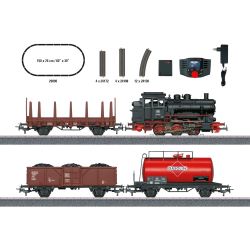
H0 centre conductor and digital operation
An introduction with C Track, Mobile Station, an mfx locomotive and a selection of freight wagons.
Open Product Details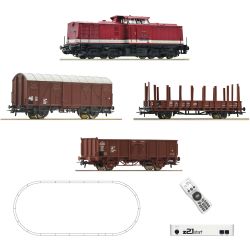
H0 two-rail and DCC
A digital H0 introduction with z21 start, handheld controller and Roco Line track with roadbed.
Open Product Details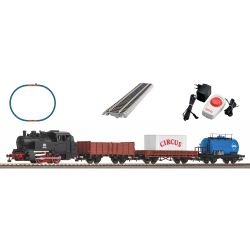
Classic analogue introduction
An analogue two-rail railway with a steam locomotive, freight wagons and easy-to-assemble track with roadbed.
Open Product Details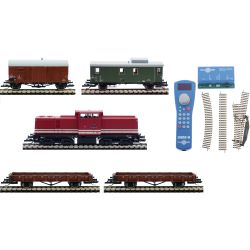
Space-saving TT nominal size
A TT freight train with a digital locomotive, track oval and a siding for varied operation.
Open Product Details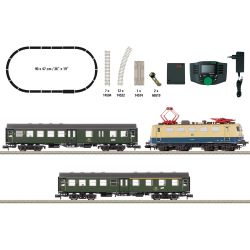
Compact digital N gauge
A digital N-gauge introduction with Mobile Station for long routes in a comparatively small area.
Open Product Details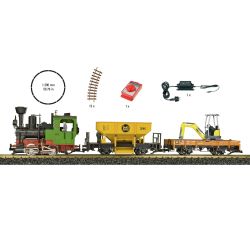
Large-scale and garden railway
Large and robust vehicles with a steam locomotive, wagons, track circle and analogue control.
Open Product DetailsExtension packs must match the existing track system exactly. Similar-looking track from different manufacturers or conductor systems is not automatically compatible.
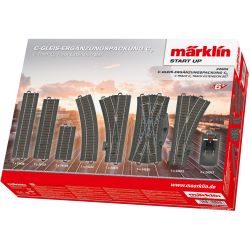
Centre-conductor track with roadbed
An extension for existing Märklin C Track layouts and suitable H0 centre-conductor railways.
Open Product Details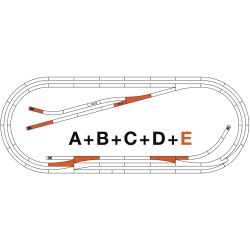
H0 two-rail track
An extension for Roco Line track plans with matching geometry and two-rail power distribution.
Open Product Details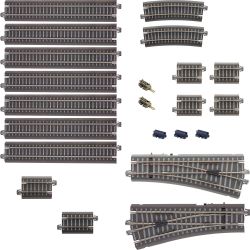
TT station extension
Track with roadbed for extending a TT layout with points and additional station tracks.
Open Product Details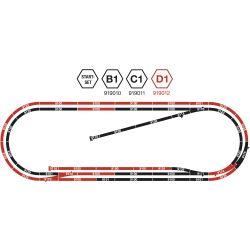
Compact track extension
An extension for compatible Fleischmann N-gauge track plans and compact layout concepts.
Open Product DetailsA larger command station becomes useful when additional trains, solenoid accessories, feedback modules, routes or network control are added. Protocol, output and system bus must suit the project.

Network-enabled DCC control
Digital control with network, app and system bus functions for extending a DCC layout.
Open Product Details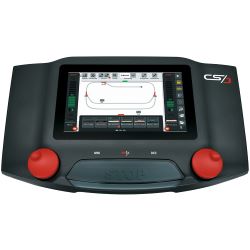
Multiprotocol command station
A command station for mfx, mfx+, Motorola and DCC with route control and extensive layout control options.
Open Product DetailsCompare analogue and digital starter packages by gauge.
Add circles, stations and extensions that match the existing system.
Select control systems by protocol, output and operating concept.
Check protocol, interface, load capacity and installation space.
Create terrain, vegetation, roads and water surfaces.
Add scale figures to stations, towns and landscapes.
Preserve reliable current pickup and smooth running.
Calculate scales, radii, gradients and model dimensions.
Brand worlds at Modellbahnshop
Products from different brands can be combined when the gauge, conductor system, wheelsets, coupling, minimum radius and digital technology match.
Answers before the first purchase decision
These answers explain space requirements, system selection, starter sets, combinations of different manufacturers and the construction of a first layout.
For many beginners, a complete starter set in H0, TT or N is particularly easy to understand. H0 offers a very large range of models, TT is a good compromise, and N permits longer routes in a small area.
The assembly size of the track plan is only the beginning. Additional clearance from the layout edge, operating space, access openings and room for buildings or later extensions are also required.
A modern digital starter set is also easy to operate in its basic form. Digital control offers more possibilities, but later expansion requires an understanding of protocols, addresses and components.
Yes. Track, points, vehicles and control equipment can be extended when they match the existing system. The exact name of the track system should therefore be recorded permanently.
Frequently, yes. The nominal size, model track gauge, conductor type, current pickup, wheelsets, coupling, minimum radius and, for digital vehicles, the protocol must match.
An oval with a station, point and siding combines continuous running with initial shunting tasks. Too many points and tight reverse curves make a first layout unnecessarily prone to faults.
Only after extensive test runs with every intended vehicle. Points, rail joints, gradients and hidden sections must operate reliably beforehand.
A matching point, siding, rerailer and suitable cleaning products generally increase the usefulness more than another locomotive without an additional operating route.
No. However, a selected era, region and railway company help to create a convincing overall impression. International trains can deliberately include vehicles from several railway administrations.
Track and wheels must remain clean, moving parts must be maintained according to the manufacturer’s instructions, and cable connections must be checked regularly. Vehicles should be stored in a dry, dust-free and secure location.
Plan a model railway that can grow
Expand your knowledge of gauges, track, digital technology, layout planning, vehicles, scenery, maintenance and prototype-based operation on the central English model railway guide page.
Go to the Model Railway GuideContent reviewed and updated: 29 July 2026. The technical specifications, safety information and assembly instructions for each individual product remain authoritative.