
Experience remains valuable
Returning to model railways does not mean starting from zero
Existing models, memories and a basic technical understanding provide a strong foundation. What must be reassessed are primarily the condition of the collection, compatibility, available space and the preferred operating concept.
Preserve the old collection, but reassess it
After a long break, locomotives should not immediately be operated at full voltage. Dust, dirty wheel surfaces, hardened lubricants, loose wires or aged traction tyres can affect the first test. Begin with a visual inspection and a small, clean test circuit.
For every vehicle, record the manufacturer, item number, gauge, method of current collection, decoder and any visible interface. Packaging and instructions help with identification. Unknown vehicles should initially be kept separate rather than opened or converted.
You do not have to rebuild the entire former layout immediately. A small oval, a shunting board or a single module quickly reveals whether you now prefer running trains, collecting, digitising, scenery construction or realistic operating procedures.
Personal progress indicator
The return-to-hobby check in eight stages
Mark completed tasks. Your selection remains stored only while this page is open.
Your route to safe trial operation
Each completed stage increases the progress indicator by 12.5 per cent.
Connecting earlier and current terminology
Classify the existing model railway collection correctly
A manufacturer name or gauge alone is not sufficient. For safe expansion, mechanical, electrical and digital characteristics must be recorded separately.
| Assessment area | Typical earlier term | Current classification | Consequence for returning to the hobby |
|---|---|---|---|
| Nominal size | Z, N, TT, H0, 0, 1 or G | Consider scale and model track gauge separately | Vehicles, track, buildings and figures must match the selected scale. |
| Current collection | Direct current or alternating current | Two-rail or centre-contact operation with a pickup shoe | Powered vehicles require the matching track and wheelset system. |
| Control | Transformer, controller or digital unit | Analogue operation or addressed digital operation | Never connect power sources together without first checking them. |
| Digital format | Märklin Digital, Selectrix or DCC | DCC, mfx or M4, Motorola, Selectrix and multi-protocol operation | The command station and decoder require at least one shared protocol. |
| Interface | Plug connector or hard-wired installation | NEM 651, NEM 652, Next18, PluX or 21MTC | Check the connector, motor current, functions and installation space together. |
| Track system | Metal track, model track or track with roadbed | Rail profile, geometry, roadbed, connectors and conductor type | Transitions frequently require suitable connectors or compensation track. |
| Coach and wagon operation | AC or DC wheelsets | Back-to-back dimension, insulation, flange and feedback detection | A vehicle may roll but still cause problems at turnouts or feedback detectors. |
| Coupling | Loop coupling or close coupling | Standard pocket, close-coupling mechanism, height and coupling head | A standard pocket simplifies replacement but does not guarantee every combination. |
Gentle recommissioning
Reactivate old locomotives, coaches and wagons safely
Work from an external inspection towards the electrical test. Unnecessary dismantling or excessive lubrication can create more problems than it solves.
Inspection without power
Inspect the body and running gear
Look for loose wires, missing screws, rust, damaged gears and seized axles.
Contact surfaces
Clean wheels and pickup shoes
Remove dirt using methods that do not damage the material. Aggressive household cleaners should not be used on paint, plastic or traction tyres.
Mechanical care
Lubricate sparingly
Use only suitable products and follow the instructions. Excess oil attracts dust.
Wear parts
Check traction tyres and motor brushes
Hardened traction tyres, worn brushes and bent pickup shoes can impair running and current collection.
First test run
Test at low speed
Stop immediately if the model hums, blocks, becomes unusually warm, produces an odour or generates excessive sparking.
Professional assistance
Have valuable models assessed
For rare or emotionally important vehicles, professional repair or digitisation is often safer than a risky do-it-yourself attempt.
Preserve, extend or modernise
Should the old layout remain analogue or become digital?
The right solution depends not on the age of the collection, but on the vehicles, desired operation, technical effort and available budget.
Retain analogue operation
Suitable for a small number of trains, familiar operation and a largely original vehicle collection.
- Continue using existing locomotives without conversion
- Separate electrical circuits for several trains
- Have old power supplies checked for safe operation
Change gradually
Selected suitable vehicles are digitised while the analogue collection remains on a separate test or operating circuit.
- Select favourite models deliberately
- Compare conversion costs in advance
- Keep analogue and digital circuits separate
Build a new digital foundation
Recommended for independent multi-train operation, sound, lighting, smartphone control and future automation.
- Select the command station by its protocols
- Begin with a test circuit and one digital locomotive
- Add accessory control and feedback later
| Return route | Especially suitable for | Check beforehand | Typical next step |
|---|---|---|---|
| Retain analogue operation | A small railway and predominantly analogue vehicles | Transformer, cables, motors and separate electrical circuits | Clean the track and establish reliable operation |
| Digitise selected vehicles | A mixed collection and selected favourite locomotives | Motor, interface, available space and decoder output | Have the first vehicle converted professionally |
| Begin again digitally | Multi-train operation and modern additional functions | Conductor system, protocols, output and digital bus | Test a command station and one compatible digital locomotive |
Old collection or a new nominal size
Which gauge fits your life today?
Returning to the hobby is a good opportunity to reassess available space, handling and the desired train length. A change of gauge is possible, but it is not automatically necessary.
- Z and Zm
- N, Nm, Ne and Nf
- TT, TTm, TTe and TTf
- H0, H0m, H0e and H0f
- S, Sm, Se and Sf
- 0, 0m, 0e and 0f
- 1, 1m, 1e and 1f
- II, IIm/G, IIe and IIf
- Special and large-railway dimensions
Remain with the previous system
This is usually the simplest route when many compatible vehicles, track sections and buildings are already available. First check whether the current space is sufficient for the required radii and train lengths.
Choose a smaller gauge
N, TT or Z gauge permits longer routes within a limited area. Small vehicles, however, require good lighting, clean track and careful handling.
Choose a larger gauge
Gauge 0, Gauge 1 and G gauge provide clearly visible detail and easier placing of vehicles on the track. They also require larger radii, more area, greater storage space and higher electrical output.
Choose narrow gauge
H0e, H0m, 0e or IIm make tight routes, small stations and distinctive mountain, branch-line or field-railway subjects possible.
Products for each project phase
Workshop equipment, digital technology and coordinated restart sets
Do not purchase replacement items indiscriminately. Begin with inspection and maintenance aids, then add a control system, decoder or new starter set according to the documented requirements.
Maintaining and inspecting existing vehicles
A secure working support and suitable maintenance products simplify the assessment of models after a long period in storage.
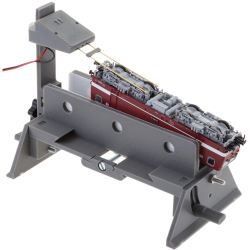
Inspect and work safely
Locomotive Cradle with Test Adapter
Secures N, TT and H0 vehicles for cleaning, maintenance and electrical testing.
Open Product Details
Sparing lubrication
Märklin 7149 Precision Oiler
A dispensing aid for approved lubrication points on locomotives, coaches, wagons and moving accessories.
Open Product Details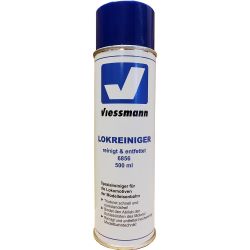
Vehicle care
Viessmann 6856 Locomotive Cleaner
A cleaning product for dismantled vehicles, to be used in accordance with the manufacturer's application and safety instructions.
Open Product DetailsControl systems and decoders for modernisation
Before purchasing, determine the conductor system, digital protocols, interface, motor current and required range of functions.
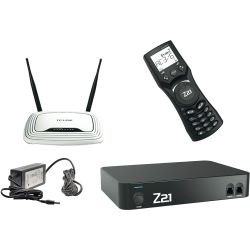
DCC and network control
Roco 10834 Z21 Professional Digital Set
A command station with WLANMAUS, router and options for app or computer control.
Open Product Details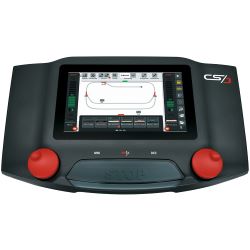
Multi-protocol system command station
Märklin 60226 Central Station 3
Touchscreen command station for mfx, mfx+, Motorola and DCC, together with extensive layout control functions.
Open Product Details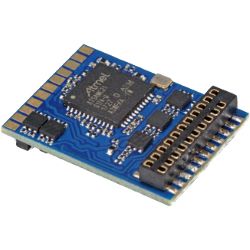
Vehicle modernisation
ESU 59649 LokPilot 5
Multi-protocol decoder for suitable vehicles with a compatible 21MTC interface.
Open Product DetailsBegin again with a coordinated starter set
A new set can serve as an independent test circuit while the former collection is assessed carefully and integrated in stages.
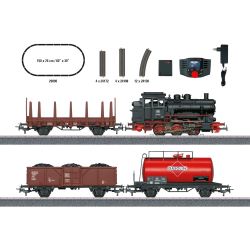
H0 centre-contact digital restart
Märklin 29890 Freight Train
A digital restart with Mobile Station, C Track and an mfx-equipped steam locomotive.
Open Product Details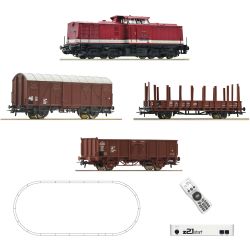
H0 two-rail digital restart
Roco 5110009 DR Freight Train
Digital set with z21 start, multiMAUS and Roco Line track with roadbed.
Open Product Details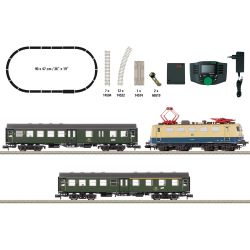
Compact restart in N gauge
Minitrix 11132 Passenger Train
A digital N-gauge package with a Mobile Station, sound locomotive and compact base area.
Open Product DetailsCleaning Vehicles
Maintain track in different gauges on a regular basis.
Locomotive Spare Parts
Find traction tyres, pickup shoes, couplings and other wear parts.
Digital Command Stations
Compare protocols, output and operating concepts.
Decoders
Select a decoder by interface and digital system.
All Starter Sets
Discover analogue and digital options for a fresh start.
Track and Turnouts
Choose a suitable system for a test circuit or new layout.
Track Sets
Build coordinated circuits, stations and extensions.
Layout Design
Develop the renewed model railway world one section at a time.
Earlier and current brand worlds
Manufacturers for maintaining collections and modern expansion
Technology and systems can change between generations within the same brand. The specifications of the exact item always remain decisive.







Answers for returning to the hobby
Frequently asked questions from returning model railway hobbyists
These answers cover older vehicles, electrical systems, digital conversions, changes of gauge and planning a new project.
How should I begin after a long break from model railways?
First record the existing collection, identify the gauge and electrical system, and then build a small, clean test circuit.
May an old locomotive immediately be operated at full voltage?
No. First inspect the vehicle, mechanism and current collection without power, then begin at a low speed.
Can an analogue locomotive operate on digital track?
Only when the system and vehicle are explicitly approved for it. For safe digital operation, an older locomotive normally requires a suitable decoder.
Can old track continue to be used?
Frequently, yes, provided the rail profile, connectors, turnouts and electrical conductors are in good condition. Severely damaged or oxidised sections should be replaced.
Can analogue and digital operation be combined?
Yes, but only on clearly electrically separated track sections. Two different power sources must never supply the same section without a proper technical assessment.
Which digital command station suits an older collection?
The decisive factors are the decoder protocols, conductor system, required layout output, preferred method of operation and any existing feedback or accessory modules.
Which decoder is suitable for an older locomotive?
Check the motor type, motor current, electrical isolation, interface, installation space, lighting and the protocol supported by the command station.
Is repairing an old model worthwhile?
Professional maintenance or repair can be very worthwhile for high-quality, rare or emotionally important vehicles.
Should I change gauge when returning to the hobby?
Only when the available space, handling requirements or desired operation have changed significantly. A large existing collection often supports remaining with the previous system.
What should be purchased first?
A safe test circuit, suitable maintenance aids, compatible connecting cables and a reliable control system generally provide more benefit than immediately buying additional vehicles.
A new project built on valuable experience
Old memories can become a new model railway project
Discover further guides covering gauges, track, digital technology, planning, vehicles, maintenance and scenery construction.
Go to the Model Railway GuideContent reviewed and updated: 29 July 2026. The instructions and technical specifications for each individual item remain authoritative.