
The quick answer
The right model railway begins with your everyday life
There is no universally best gauge. The right railway is the one whose space requirements, model size, handling and train lengths suit your available area and intended use.
The most attractive locomotive should not make the first decision
Begin by measuring the area that is actually usable. Include the layout edge, operating aisle, doors, furniture, radiators, sloping ceilings and maximum comfortable reach. A layout whose rear tracks cannot be reached soon becomes impractical, even with the most attractive vehicles.
Then consider what should happen on the layout. Long InterCity or freight trains require different conditions from a small branch-line station, shunting layout, field railway or garden railway. Your preferred viewing style is also important: do you want to see scenery and the effect of a long route, or observe individual vehicles with many visible details?
Only then should you choose the track system , analogue or digital control, era and railway company. In H0, two-rail and centre-conductor vehicles must also be distinguished. A coordinated starter set reduces these initial technical decisions.
Interactive decision aid
Which model railway suits your requirements?
The finder compares widely used standard-gauge, narrow-gauge, field-railway and garden-railway sizes. The result is a planning recommendation. The permitted minimum radius and full technical information for each individual product remain authoritative.
Direct recommendations by requirement
Six typical requirements and their suitable model railway worlds
This classification helps when you do not yet prefer a particular gauge or want to compare the result from the finder.
Very little space
Z or N Gauge
Z saves an especially large amount of space. N is slightly larger but easier to handle and provides very good opportunities for long routes, stations and extensive scenery.
Compromise between size and route length
TT Gauge
TT lies between H0 and N. The models remain clearly visible, while stations and curves can be planned more generously within a medium-sized area.
Maximum product range
H0 Gauge
H0 offers a particularly wide selection of vehicles, track systems, buildings and digital products. Powered vehicles must be distinguished between two-rail and centre-conductor versions.
Small railway with strong character
H0e, H0m or H0f
Narrow-gauge and field railways allow short trains, tight routes and scenery-focused themes such as mountains, quarries, sawmills and light railways.
Large models and shunting
Gauge 0
Modules, shelves and segments can provide intensive shunting tasks with clearly visible vehicle technology, sound and remotely controlled couplings.
Garden, terrace and long-distance visual effect
G Gauge or IIm
Large vehicles, robust track and scenery with a strong visual effect make this a widely used choice for indoor and garden railways.
From Z to large passenger-carrying railways
Classifying the important model sizes and track gauges
The table includes widely available production sizes as well as narrow-gauge, field-railway and large-railway variants. For uncommon sizes, the actual product selection is frequently limited to small-series models and scratch-building.
| Model size and variants | Typical scale | Standard gauge in the model | Particular strength | Typical suitability |
|---|---|---|---|---|
| Z and Zm | 1:220 | 6.5 mm | Very long routes within the smallest area. | Shelf, tabletop, case and scenery-focused layouts. |
| N, Nm, Ne and Ni/Nf | 1:160 | 9 mm | Long trains and generous stations with modest space requirements. | Rented homes, main lines and extensive landscapes. |
| TT, TTm, TTe and TTi/TTf | 1:120 | 12 mm | A balanced combination of model size and route length. | Medium-sized areas, DB, DR and Central European themes. |
| H0, H0m, H0e and H0i/H0f | 1:87 | 16.5 mm | A very large range for standard-gauge, narrow-gauge and field railways. | Beginners, collectors, layout builders and digital operation. |
| S, Sm, Se and Si/Sf | 1:64 | 22.5 mm | Large and clearly recognisable vehicles. | Specialist collections and international themes. |
| 0, 0m, 0e and 0i/0f | Usually 1:45 | 32 mm | Strong detail and intensive shunting operation. | Modules, segments, shelf layouts and branch lines. |
| I/1, Im, Ie and Ii/If | 1:32 | 45 mm | Large models with extensive technology and strong visual presence. | Large rooms, collections and exhibition layouts. |
| II, IIm/G, IIe and IIi/IIf | 1:22.5 | 64 mm; IIm usually 45 mm | Large narrow-gauge and garden-railway worlds. | Gardens, terraces, large indoor layouts and dioramas. |
| III and narrow-gauge variants | Approximately 1:16 | 89 mm | Very strong model presence and visible mechanics. | Hand-built models, garden railways and specialist layouts. |
| V, VII, X and special dimensions | Approximately 1:11 to 1:5.5 | 127 to 260 mm | Some garden and park railways can carry passengers. | Specialists with extensive space and safety requirements. |
Define the technology after choosing the gauge
Analogue, digital, two-rail or centre conductor?
These terms describe different technical levels. Analogue or digital concerns the control system. Two-rail or centre conductor describes, especially in H0, how power is collected through the track and vehicle.
Analogue for a straightforward start
A controller changes the voltage in the track. This is easy to understand for one train and is suitable for small circuits, shunting boards, field railways and seasonal layouts.
- Little technical equipment
- Straightforward operation
- Several independent trains require separate electrical circuits
Digital control for several locomotives
Each locomotive receives an address. Several vehicles can operate independently on the same track. Depending on the model, lights, sound and shunting functions can be switched separately.
- Independent multi-train operation
- Switchable vehicle functions
- Can later be expanded with points, feedback and automation
H0 two-rail or DC
The two rails carry separate poles. Locomotives require suitable two-rail current pickup and electrically isolated wheel sides. DCC is widely used on digital two-rail layouts.
H0 centre conductor or AC
Contact studs in the centre of the track supply the locomotive through a pickup shoe. mfx, Motorola and DCC are among the formats used in the Märklin environment.
The gauge also follows the operating concept
Which layout theme suits your way of enjoying model railways?
The same area can be used very differently as a main line, shunting module, narrow-gauge railway or diorama.
Long main-line trains
N and Z make especially efficient use of the available room length. TT is a good middle ground, while H0 requires correspondingly more space for long platforms and hidden stations.
Classic home layout
H0 offers the widest selection and straightforward handling. TT saves space without appearing extremely small. Both are suitable for stations, branch lines, freight operation and scenery.
Shunting layout or industrial siding
Short trains make H0 and Gauge 0 attractive even on narrow segments. A goods shed, loading road and works siding provide operation without requiring an endless circuit.
Mountain and narrow-gauge railway
H0e, H0m and G Gauge suit narrow valleys, viaducts and small stations. Prototype themes range from Saxon narrow-gauge railways to the Rhaetian Railway.
Collection and display cabinet
H0 provides a very large variety of models. Gauge 0 and Gauge 1 show impressive details but require considerably more display, transport and operating space.
Family or garden railway
Large vehicles are clearly visible and easier to place on the track. G Gauge is particularly widespread for outdoor layouts; the power supply and storage must be planned with weather protection.
Coordinated starting points
Suitable starter sets by gauge and intended use
These examples show different routes from straightforward analogue operation to digital multi-train control and a large garden railway. Before selecting a set, check the required base area, track system and intended later expansion.
Compact and balanced model railway worlds
These sets suit small and medium-sized indoor layouts and demonstrate the differences between N, TT and H0 especially clearly.
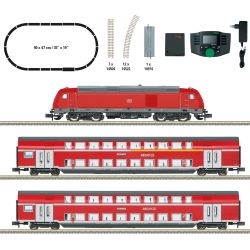
N Gauge · Digital · Regional transport
Minitrix 11164 Regional Express
Modern regional transport with an mfx and DCC decoder, sound and the compact visual effect of N Gauge for longer routes.
Open Product Details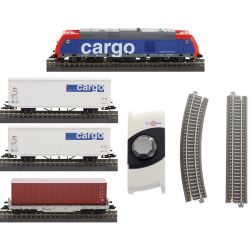
TT Gauge · Analogue · Freight operation
Tillig 01501 SBB Freight Train
TT combines clearly visible models with space-saving track geometry. The track oval with roadbed simplifies initial assembly.
Open Product Details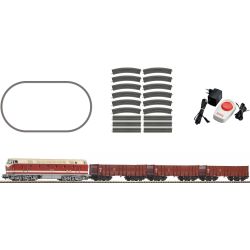
H0 Gauge · Analogue · Deutsche Reichsbahn
PIKO 57138 Class 119 with Freight Wagons
An analogue H0 introduction with clearly visible vehicles, a track oval with roadbed and a classic Era IV freight train.
Open Product DetailsDigital multi-train operation and large garden-railway presence
This selection suits more extensive functions, several vehicles or especially large and robust models.
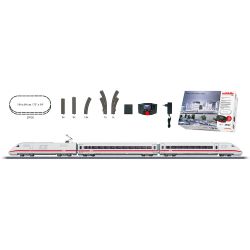
H0 centre conductor · Digital · Long-distance transport
Märklin 29792 ICE 2
A digital H0 introduction with C Track, Mobile Station and a modern high-speed train formation.
Open Product Details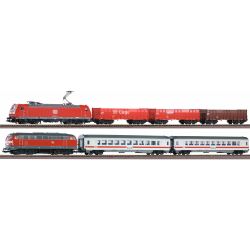
H0 two-rail · Two trains · WLAN
PIKO 59014 SmartControl WLAN
Two independently controlled trains, track with roadbed and digital operation for passenger and freight traffic.
Open Product Details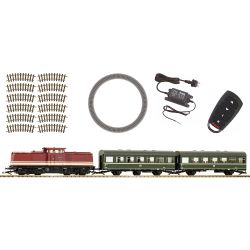
G Gauge · Radio control · Large railway
PIKO 37145 Class V 100 Passenger Train
Large DR vehicles, a track circle and radio control for an impressive indoor or garden railway.
Open Product DetailsAll Starter Sets
Compare gauges, themes and control systems together.
Analogue Starter Sets
Straightforward train operation with manageable technology.
Digital Starter Sets
Operate several locomotives and use switchable functions.
Tracks and Turnouts
Select the correct system by gauge and conductor type.
Track Sets
Add circuits, stations and sidings to a coordinated system.
Digital Command Stations
Compare protocols, output and operating concepts.
Layout Design
Build scenery, terrain, roads and vegetation.
Model Railway Calculators
Calculate scale, radius, gradient and model dimensions.
Choose brands by gauge and system
Important manufacturers for different model railway routes
A brand name does not replace a technical check. Different gauges, track systems and generations of digital technology may exist within the range of a single manufacturer.







Decisions with a long-term effect
Selection mistakes you should avoid
Most later problems are not caused by an individual brand, but by buying too early without checking the available area and technical system.
Choosing only by a favourite locomotive
Check whether suitable radii, platforms and storage tracks can realistically fit within the available area.
Automatically choosing the smallest gauge
Small models save space but require more care when placing vehicles on the track, cleaning and coupling.
Confusing H0 AC and H0 DC
Both use the same model track gauge but differ in current pickup, track and vehicle design.
Planning only the starter-set circuit
A later station, longer coaches or large steam locomotives may require considerably larger radii and usable track lengths.
Mixing track systems without checking them
Rail-profile height, roadbed, joiners, geometry and conductor type must be technically compatible at every transition.
Filling the entire area with track
Open scenery, accessible track and a clear operating sequence generally look more convincing than an overloaded layout.
Direct answers before the first purchase
Frequently asked questions about choosing the right model railway
These answers help with rented homes, small spaces, manufacturer selection, control systems and long-term expansion.
Which model railway suits a rented home?
N and TT are well suited to compact, mobile or segmented layouts. H0 is also possible when a branch-line, shunting or wall-mounted concept is selected instead of a large main-line layout.
Which gauge is suitable for an area of approximately 2 × 1 metres?
N allows a considerable route length within this area. TT provides a good compromise. In H0, a straightforward oval, branch line or shunting layout is possible, but long main-line trains remain restricted.
Which gauge is best for long trains?
N and Z permit especially long trains in relation to the room length. TT is a balanced alternative. H0 requires larger curves and longer station tracks for long express and freight trains.
Which model railway is particularly easy to handle?
H0 is a good middle ground between model size, visibility and space requirements for many people. Gauge 0, Gauge 1 and G provide even larger vehicles but require considerably more area.
Should I begin with analogue or digital control?
Analogue control is sufficient for one train and straightforward operation. Anyone who wants to control several locomotives independently, use sound or automate later should consider a digital introduction.
Which model railway is suitable for children and families?
Large, clearly visible models and robust track with roadbed make shared assembly easier. The product age recommendation, small parts that may be swallowed and adult supervision remain decisive.
Can products from different manufacturers be combined?
Yes, when the gauge, conductor system, current pickup, wheelsets, couplings, radius and, for digital vehicles, at least one shared protocol match.
Which railway suits someone who prefers collecting to building?
H0 provides a particularly large variety of themes and models. Z and N require little display space. Gauge 0 and Gauge 1 create a strong individual-model effect but require considerably more room.
Is a starter set better than buying individual components?
Usually yes for a first introduction because the locomotive, rolling stock, track and controller are coordinated. Buying individual components provides greater freedom but requires a precise compatibility check.
Can I change to another gauge later?
A change is possible but usually requires new vehicles, track, buildings and accessories. Anyone who remains uncertain should first view real models or begin with a small starter set or test oval.
Turn the recommendation into a personal project
Develop your selection into your own model railway project
Explore further guidance about gauges, track systems, digital technology, eras, railway companies, layout construction and maintenance.
Go to the Model Railway GuideContent reviewed and updated: 29 July 2026. The technical specifications and safety information for each individual product remain authoritative.