Single-Track Portal
Suitable for branch lines, narrow gauge, mountain routes and older main lines. The smaller opening is easier to integrate into a narrow hillside or rock cutting.

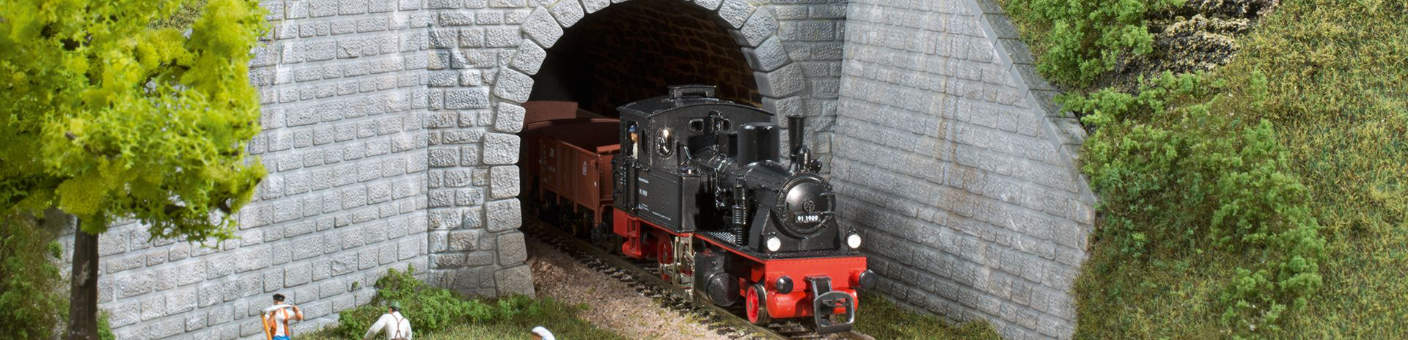
Find the right model railway tunnel portal for a branch line, main line, narrow-gauge railway, overhead-line operation, modern high-speed route or individually built tunnel entrance.
Choosing tunnel portals by gauge, number of tracks and style begins with the technical railway route. The portal must suit the model scale, the track system, the number of tracks, the position of curves and the largest vehicles that will operate through it. Only then should the masonry, era and scenery theme be selected.
The external dimensions stated for a product do not automatically describe its free internal opening. This is especially important when the portal is located on a curve: the ends of a long coach swing towards the outside while its centre moves towards the inside. A portal that is sufficiently wide on straight track may therefore be too narrow on a curve.
Electric locomotives add the height of the pantograph to the equation. A portal described as suitable for overhead lines makes planning easier but does not replace a practical check with the contact wire, supports and actual vehicle.
The visual decision comes last. Rubble stone often suits historic branch lines and mountain railways, concrete suits modern main lines, rock portals suit natural cuttings and facing or decorative panels allow individually constructed tunnel entrances.
Selecting colour or masonry first risks ending up with an opening that is too small. The following sequence therefore begins with the vehicles and track geometry.
| Check | Key Question | Consequence for the Portal |
|---|---|---|
| 1. Scale | Which model scale is being used? | Wall texture and basic dimensions must suit H0, TT, N, Z or G. |
| 2. Model Track Gauge | Standard gauge or narrow gauge? | H0m and H0e require a different profile from standard-gauge H0. |
| 3. Number of Tracks | Does one track or do two tracks pass through the opening? | Check the portal width and, with two tracks, the track spacing. |
| 4. Track Alignment | Is the portal on straight track or on a curve? | Curves require additional lateral clearance for long vehicles. |
| 5. Traction | Will electric locomotives operate beneath visible overhead wiring? | The opening, contact wire and pantograph require sufficient height. |
| 6. Prototype | Which era, region and route type are being represented? | Only now should natural stone, rubble stone, concrete or rock appearance be selected. |
A product width of, for example, 13 centimetres does not mean that the free opening is also 13 centimetres wide. The actual internal opening at track level is what matters.
The number of tracks affects more than the width. It also changes the visual character of the structure and the type of railway scene for which it is suitable.
Suitable for branch lines, narrow gauge, mountain routes and older main lines. The smaller opening is easier to integrate into a narrow hillside or rock cutting.
Suitable for main lines and larger layouts. Track spacing, passing vehicles and overhang on curves must all be checked together.
Two single-track portals may look more convincing than one wide opening on mountain routes that were doubled later or on certain modern tunnel projects.
Some kits can be assembled for one or two tracks. They are useful when the wing walls and opening need to be adapted individually to the track plan.
A portal can look correct to scale and still be too tight for reliable operation. The safest method is to position a temporary portal template and test it with the longest vehicle.
| Operating Situation | Area to Check | Suitable Test |
|---|---|---|
| Straight Track | vehicle width, roof and lateral safety clearance | slowly push the tallest and widest vehicle through |
| Portal on the Outside of a Curve | outward-swinging vehicle ends | guide the longest coach past the portal and wing wall |
| Portal on the Inside of a Curve | lateral displacement of the vehicle centre | observe the centre of the coach at the narrowest point |
| Double-Track Curve | two long vehicles passing each other | position vehicles on both tracks at the same time |
| Overhead Line | contact wire, supports and pantograph | check with the pantograph in its intended operating position |
| Narrow Gauge | smaller prototype loading profile at the same scenery scale | compare an H0m or H0e portal directly with the actual vehicles |
Current NEM guidance, manufacturer dimensions and the actual track plan are decisive for technical limits. A practical test run remains essential.
A short straight section before the tunnel entrance improves operational reliability and often looks more prototypical. Where this is impossible, the opening must be made correspondingly more generous.
Once the technical opening has been established, the portal can be matched to the prototype being represented.
A versatile choice for historic main lines, branch lines, mountain railways and rural scenery from Eras I to VI.
Especially suitable for towns, industrial districts and northern German or British-influenced railway settings.
Clean lines and large openings suit modernised main lines, high-speed routes and more recent eras.
Rock castings, decorative panels and portal facings allow custom openings and especially close integration into individual landscapes.
| Layout Theme | Suitable Portal Character | Suitable Addition |
|---|---|---|
| Historic Branch Line | single-track, rubble stone or brick | small wing walls, soil and dense vegetation |
| Mountain Railway | natural stone, rock portal or separate bores | rock face, scree and protective retaining wall |
| Classic Main Line | large stone portal with sufficient overhead-line height | tunnel lining, cable ducts and signals |
| Modern High-Speed Route | concrete or high-speed portal | overhead line, emergency walkway and technical equipment |
The current shop selection is strongest in H0, TT, N, Z and G. For S, Gauge 0 and Gauge 1, construction panels, rock moulds and individually built portal openings may be useful alternatives.
| Gauge | Scale | Typical Model Track Gauge | Selection Note |
|---|---|---|---|
| Z | 1:220 | 6.5 mm | use fine portals or facing portals with very small openings |
| N and Nm | 1:160 | 9 mm or narrow gauge | single- and double-track portals plus modern high-speed styles are available |
| TT, TTm and TTe | 1:120 | 12 mm or narrow gauge | do not substitute an H0 portal simply because its physical size appears similar |
| H0 | 1:87 | 16.5 mm | widest selection of stone, concrete, kit and overhead-line portals |
| H0m , H0e and H0f | 1:87 | 12, 9 or 6.5 mm | select dedicated narrow-gauge portals despite the identical scenery scale |
| S, Sm and Se | 1:64 | 22.5 mm or narrow gauge | openings are often constructed individually from panels or castings |
| Gauge 0, 0m and 0e | usually around 1:45 | 32 mm or narrow gauge | allow for a large opening and sufficiently wide maintenance access |
| Gauge 1, Im and Ie | 1:32 | 45 mm or narrow gauge | portals are often built as stable but lightweight custom structures |
| G and IIm | prototype-dependent, often around 1:22.5 | frequently 45 mm | consider weather resistance and drainage on outdoor layouts |
Manufacturers differ in material, architectural style, available gauges and the scope of their portal sets.





Filter the portal selection by gauge, manufacturer, number of tracks, overhead-line or narrow-gauge operation and architectural style. Additional products are loaded from both pages of the current English tunnel category and checked for reachable, non-archived product pages.
The verified product selection is displayed.
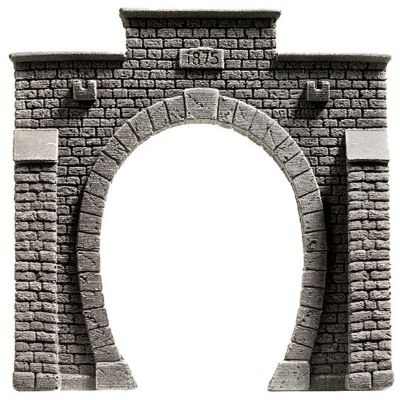
Stone portal for H0 routes, including layouts with overhead lines.
View Product →
Wide textured rigid-foam stone portal for two H0 tracks.
View Product →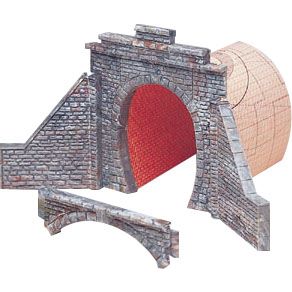
Portal kit that can be adapted for single- or double-track operation.
View Product →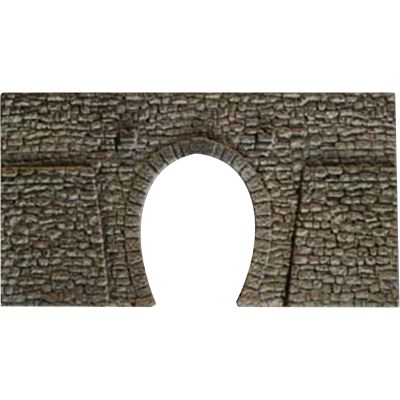
Hand-coloured opening for classic railway scenery.
View Product →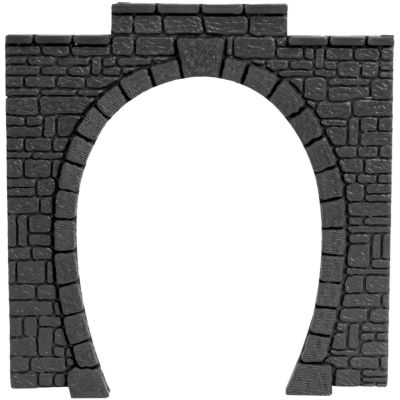
Two robust portals for a single-track H0 tunnel route.
View Product →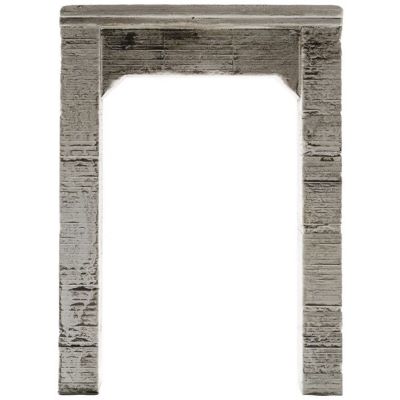
Clean modern form for a single-track railway route.
View Product →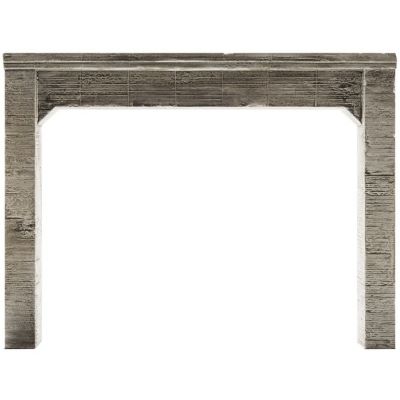
Double-track concrete opening for modern main-line and urban routes.
View Product →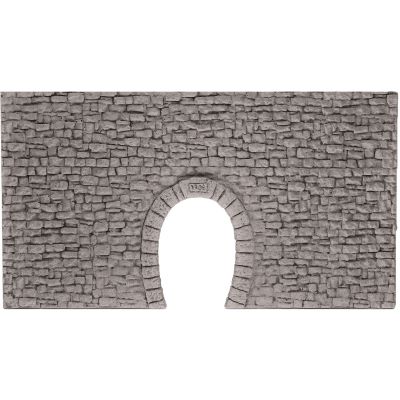
Narrower rubble-stone opening in 1:87 scenery scale.
View Product →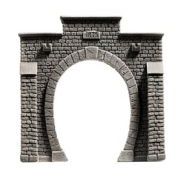
Hand-coloured stone portal for TT branch and main lines.
View Product →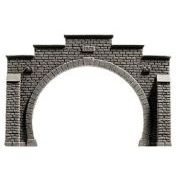
Wide TT portal with finely textured stone surface.
View Product →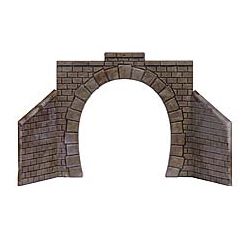
Compact portal for a single-track TT railway route.
View Product →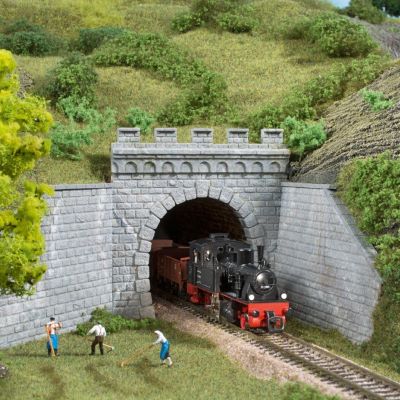
Two portals for steam and overhead-line operation.
View Product →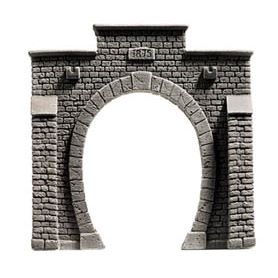
Small stone-wall opening for a single N-gauge track.
View Product →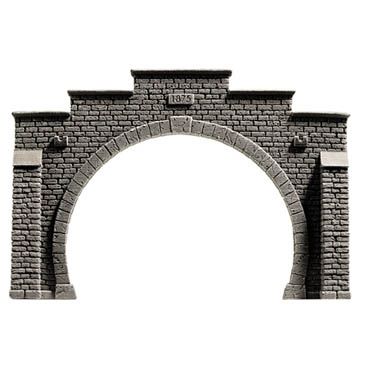
Double-track N-gauge opening with stone-wall texture.
View Product →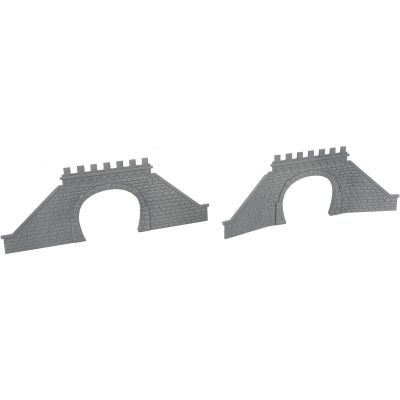
Two stone portals for a double-track N-gauge route.
View Product →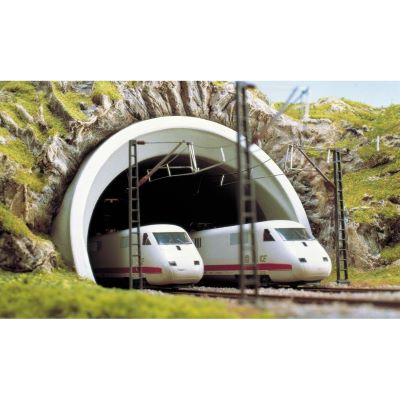
Modern double-track opening for overhead-line operation.
View Product →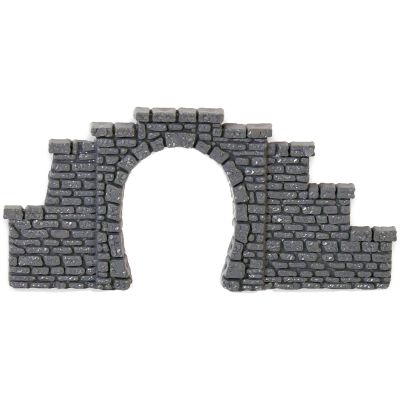
Two compact portals for a Z-gauge railway.
View Product →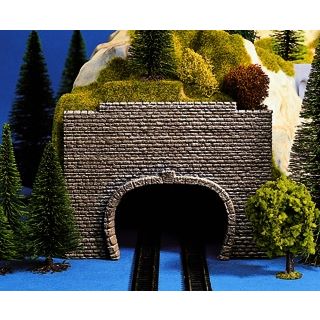
Double-track portal facing for individually constructed entrances.
View Product →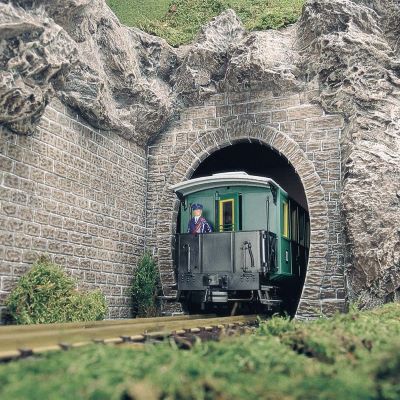
Large portals for indoor and garden railway layouts.
View Product →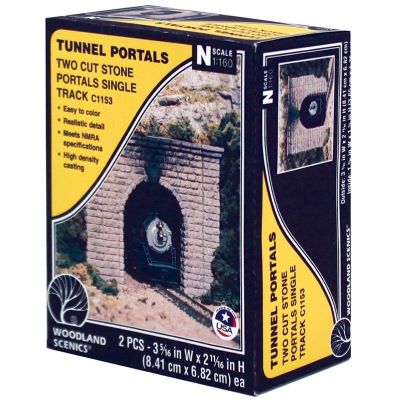
Two plaster portal castings that can be individually coloured.
View Product →Complement the chosen opening with tunnel lining, wing walls, rocks, scree and a permanently accessible maintenance area.
Portals, ready-made tunnels, corner tunnels and interior walls.
Wing walls, rock textures and individually built openings.
Shape portal edges and terrain transitions.
Add masonry colours, soot and moisture staining.
Allow for contact wire and pantograph clearance inside the portal.
Blend the tunnel entrance naturally into the foot of the mountain.
Add scale vegetation to the portal slope and rock cracks.
Fix portals, rigid foam, walls and scenery securely.
This sequence prevents an attractive portal from later proving technically unsuitable.
Portal texture and dimensions must suit the visible model railway world.
H0m and H0e use smaller tunnel portals than standard-gauge H0.
With two tracks, also check the actual track spacing.
The vehicle ends and centre must not touch the portal.
The portal height must suit the planned contact-wire position.
Branch lines, Alpine routes and high-speed lines require different structures.
A cardboard template makes it easier to check the actual installation location.
The portal and visible tunnel tube should appear to form one complete structure.
A common mistake is to test only the locomotive. Long passenger coaches and articulated vehicles often need considerably more lateral clearance on curves. A pantograph can also reach well above the vehicle roof.
Another mistake is choosing solely by the printed model gauge. A portal may suit the nominal scale but still be too tight for the actual radius, track spacing or overhead line.
Finally, the portal should not be considered in isolation. Tunnel lining, wing walls, the mountain connection and maintenance access all need additional space behind the visible front.
Check the actual clear passage separately.
The longest coach often determines the required curve clearance.
The same scenery scale does not mean the same vehicle profile.
Plan the contact wire and portal height together from the beginning.
Permanently fix the portal and landscape only after successful test runs with different vehicles, passing trains and, where applicable, the planned overhead line.
These answers help with the number of tracks, overhead lines, narrow gauge, curve position and a suitable scenic appearance.
The required size depends on the model scale, vehicle loading profile, number of tracks, curve radius and overhead line. The free internal opening is decisive, not the overall external dimensions of the product.
A large H0 opening may work technically but can look oversized. Dedicated H0m and H0e portals reproduce the smaller narrow-gauge loading profile more convincingly.
Position a temporary portal template and slowly move the longest coach through the area in both directions. Check both the vehicle ends and the centre of the coach.
In addition to the portal width, check the track spacing and two long vehicles passing each other. Additional lateral clearance may be required on curves.
The product description often explicitly states that the portal is suitable for overhead lines. The contact wire, supports and operating position of the pantograph must nevertheless be checked in practice.
Single-track natural-stone, rubble-stone or brick portals are often particularly suitable. The region, era and surrounding retaining walls should use a coherent style.
Concrete portals and modern high-speed designs suit contemporary main lines and high-speed routes. Technical details and suitable overhead wiring reinforce the modern appearance.
It depends on the prototype. Separate tunnel bores can look more convincing on mountain routes doubled at a later date or on certain modern tunnel projects.
The area visible from normal viewing angles should be lined. This prevents bare layout construction or untreated wood from remaining visible behind the opening.
Yes. Construction panels, rock castings, decorative panels and portal facings allow custom openings. The required technical clearance must remain fully available.
A ready-made single-track portal on straight track is particularly easy to work with. It can be tested easily and then supplemented with tunnel lining, walls and scenery.
Only after successful test runs with all important vehicle types, the intended track spacing and, where applicable, the fully planned overhead line.
Use the filters for gauge, number of tracks, overhead-line operation and portal type and then compare the actual opening directly at the planned installation location.
Open the Main Model Railway Guide
Content reviewed on 16 August 2026. Product dimensions, the actual vehicles used, track geometry and the instructions supplied by the respective manufacturer remain authoritative.