
21MTC: Versatile Decoder Interface for H0 and Gauge 0
What does 21MTC mean, why are 22 positions visible and how do standard and MKL decoders differ? This guide explains NEM 660, the contacts, sound, installation, gauges and correct decoder selection for digital model railways.
21 Contacts
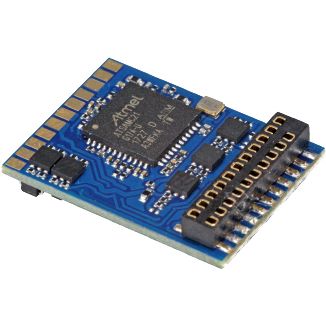
Digital interface according to NEM 660
What Is a 21MTC Interface?
21MTC is a standardised connection between a model locomotive's main circuit board and a digital decoder. The vehicle circuit board carries two rows of fine contact pins. The decoder has a matching female header and is plugged directly onto the pins. This connects the motor, lighting, loudspeaker, auxiliary functions and additional signals without extensive individual wiring.
At first glance, 22 positions are present. However, one position is omitted or blocked as a mechanical key. Consequently, only 21 electrical contacts are used. The key assists with aligning the decoder and vehicle circuit board correctly. Nevertheless, a decoder must never be fitted using force.
The interface is particularly common in extensively equipped H0 locomotives. It is found in both two-rail vehicles and centre-contact models. 21MTC therefore determines neither the track system nor the digital format. Depending on its design, a decoder may support DCC , Motorola, Selectrix or several protocols.
The abbreviation MTC is frequently explained as “Multiple Train Control”. In practice, it is more important that the interface provides numerous connections within a comparatively small area. It is therefore suitable for locomotives with sound, cab lighting, shunting lights, smoke generators or other switchable functions.





Contacts, installation space and functions
How Is 21MTC Constructed Technically?
The standard defines the contact positions, mechanical dimensions and electrical functions. The options that can actually be used additionally depend on the decoder and vehicle circuit board.
Which Connections Does 21MTC Provide?
The basic contacts include the two track connections, motor connections and the power supply for the decoder and lighting. Depending on the design, front and tail lights, the loudspeaker, additional function outputs, sensors and a vehicle bus may also be connected.
The standard considers different motor types. These include conventional DC motors, coreless motors and certain AC motors with field coils. The decisive question, however, is whether the selected decoder is permitted to control the installed motor and can handle its current consumption.
Up to eight function outputs and several sensor inputs may be provided. Alternatively, certain contacts can be used for additional outputs. A locomotive circuit board does not have to use all these options. A decoder with numerous outputs therefore does not automatically create additional functions in a more simply constructed vehicle.
Same connector, important differences
Standard 21MTC or 21MTC MKL?
A mechanically matching socket alone is not sufficient when selecting a decoder. Certain Märklin vehicles in particular require the expected electrical version to be checked.
21MTC According to NEM 660
The standards-compliant version uses logic levels for certain auxiliary functions. It is provided in numerous vehicles from different manufacturers. The product description and instructions should state explicitly that it is suitable for the locomotive.
21MTC MKL
Some Märklin locomotives expect AUX3 and AUX4 to be amplified outputs. Manufacturers provide decoders identified as MKL for these vehicles. MKL is not a completely different connector shape, but an electrically different implementation of individual connections.
Important Selection Rule
Do Not Distinguish Standard and MKL by Appearance Alone
A mechanically compatible decoder may fail to operate functions correctly or may place stress on components when the wrong output type is used. Consult the vehicle instructions, the replacement part number of the original decoder or an unambiguous manufacturer recommendation.
From Z gauge to garden railways
Which Gauges Are Suitable for 21MTC?
A decoder interface does not belong permanently to one gauge. The vehicle size, available installation space, motor output and required functions determine which solution is appropriate.
| Gauge | Typical Use of 21MTC | Classification | Common Alternatives |
|---|---|---|---|
| Gauge Z | Practically unused because of the extremely limited space. | Very Rare | Permanently wired subminiature decoders |
| Gauge N | Conceivable only in exceptionally spacious vehicles. | Rare | Next18, NEM 651, MTC14 or E24 |
| Gauge TT | Individual applications are possible, but it is too large for many TT models. | Relatively Rare | Next18, PluX12 or PluX16 |
| Gauge H0 | Locomotive, function and sound decoders in two-rail and centre-contact vehicles. | Main Application | PluX22, Next18, NEM 652 or manufacturer-specific boards |
| H0e and H0m | Only in sufficiently wide or long narrow-gauge vehicles. | Rare | Next18 or small wired decoders |
| Gauge 0 | Possible in vehicles with moderate motor current and a suitable main circuit board. | Possible | Larger locomotive and sound decoders |
| Gauge 1 | Only in specialist designs with a decoder of sufficient capacity. | Unusual | Large-scale and high-current decoders |
| G and IIm | Generally not sufficiently powerful for typical garden railway vehicles. | Hardly Used | Massoth and other large-scale decoders |
Is 21MTC Suitable for H0 AC and H0 DC?
Yes. In principle, the interface can be used in both system families. In H0, the designations AC and DC primarily describe current pickup, wheelsets and the track system. The decoder must suit the motor, vehicle and digital command station.
A centre-contact vehicle may, for example, contain a multiprotocol decoder supporting DCC and Motorola. Conversely, a two-rail vehicle may contain a DCC-only decoder. The shape of the 21MTC socket alone does not provide reliable information about the protocol.
Classifying connector types correctly
21MTC, PluX22, Next18 and NEM 652 Compared
No interface is universally better. The socket fitted to the vehicle is decisive. Changing between different systems requires a suitable adapter board or new wiring.
| Interface | Contact Arrangement | Typical Gauges | Range of Functions | Special Feature |
|---|---|---|---|---|
| 21MTC | Vehicle with pins, decoder with a socket | Mainly H0 and some Gauge 0 vehicles | Numerous functions and sound are possible | Check the standard and MKL versions |
| PluX22 | Decoder with pins, vehicle with a socket | H0 and individual larger TT models | Numerous amplified outputs and sound | The mechanical arrangement is significantly different |
| Next18 | Compact, flat plug-in connection | N, TT, small H0 and narrow gauge | Several functions and sound with Next18-S | Significantly smaller installation space |
| NEM 652 | Eight-pin wired plug | Mainly older H0 vehicles | Basic functions; extensions are often connected separately | Simple, but with fewer connections |
A more detailed comparison is available in the decoder interface comparison .
Insert the decoder safely
Install and Test a 21MTC Decoder for the First Time
Work only on a vehicle with the power switched off. Follow the locomotive manufacturer's instructions and protect the decoder and circuit board from mechanical stress and electrostatic discharge.
Identify the Version
Check whether the locomotive requires a standard or MKL decoder.
Open the Vehicle
Remove the body according to the instructions without placing stress on sensitive wires.
Remove the Analogue Plug
Pull the blanking plug evenly and straight off the contact pins.
Check the Key
The missing contact position must align with the blocked socket position.
Confirm the Orientation
Check the board side and intended orientation against the instructions.
Fit the Decoder
Press it straight and evenly onto the pins without tilting it sideways.
Maintain Clearance
Avoid contact with metal, trapped wires and obstructed heat dissipation.
Use the Programming Track
Read the decoder first to identify possible connection faults early.
Check the Functions
Test the motor, direction, lights, auxiliary functions and sound individually.
Close the Body
Reassemble all components without mechanical stress only after a successful test.
Fault After Installation
Switch Off Immediately in the Event of a Short Circuit or Unusual Heat
If the locomotive remains stationary, the light flickers or the decoder becomes hot quickly, do not continue repeating the test. Check for bent contact pins, incorrect alignment, standard or MKL compatibility, contact with metal and the permitted motor load.
Decoders and accessories by application
Suitable 21MTC Products for H0, Gauge 0 and Conversions
The following selection includes universal locomotive decoders, function decoders, sound decoders and adapters. Also check the current capacity, protocols, dimensions, loudspeaker and vehicle assignment on the respective product page.
Gauge H0 and Selected Gauge 0 Vehicles
21MTC Locomotive and Function Decoders
Locomotive decoders control the motor, lighting and auxiliary functions. Function decoders are suitable for control cars, illuminated coaches and other vehicles without their own traction motor.
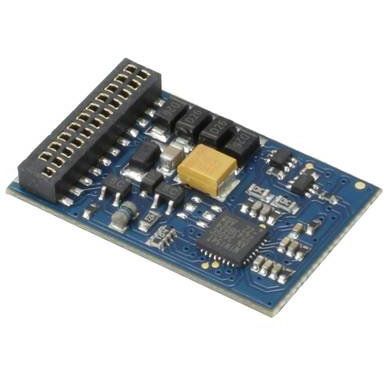
H0 Locomotive Decoder
ESU 59029 LokPilot 5 Basic
Basic DCC locomotive decoder with a standards-compliant 21MTC interface.
View Product
Multiprotocol
ESU 59619 LokPilot 5
Versatile locomotive decoder for several common digital protocols.
View Product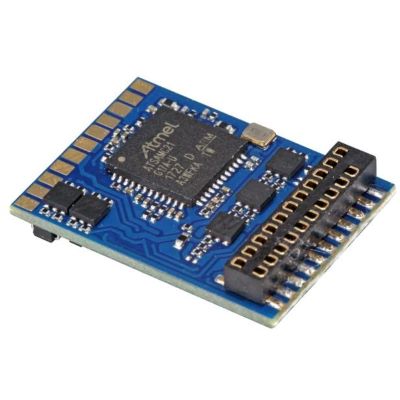
DCC
ESU 59629 LokPilot 5 DCC
21MTC locomotive decoder for layouts operated consistently with DCC.
View Product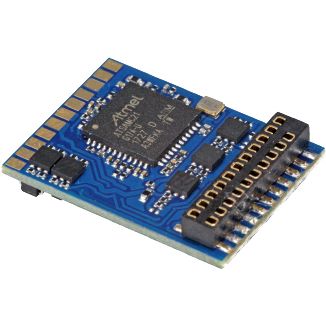
21MTC MKL
ESU 59649 LokPilot 5 MKL
MKL version with amplified auxiliary functions for suitable vehicles.
View Product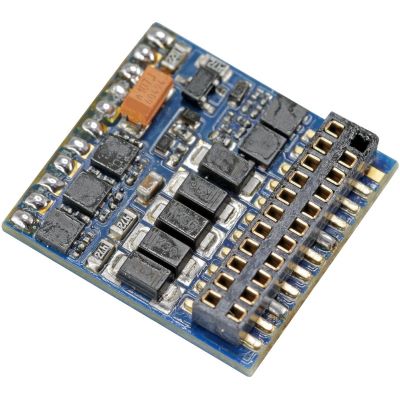
Function Decoder
ESU 59219 LokPilot 5 Fx
Multiprotocol function decoder for coaches and unpowered vehicles.
View Product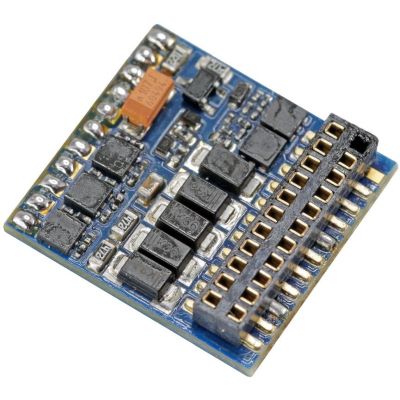
DCC Function
ESU 59229 LokPilot 5 Fx DCC
DCC function decoder for lighting and additional switching tasks.
View Product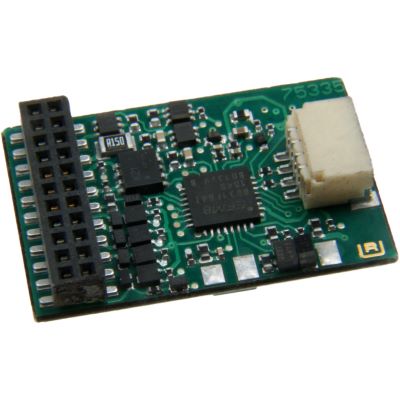
H0 and Gauge 0
Uhlenbrock 75335 IntelliDrive 2
Locomotive decoder with a 21MTC connection and extensive motor control.
View Product
Locomotive Decoder
tams LD-G-33 plus
21MTC locomotive decoder for versatile digitisation projects.
View Product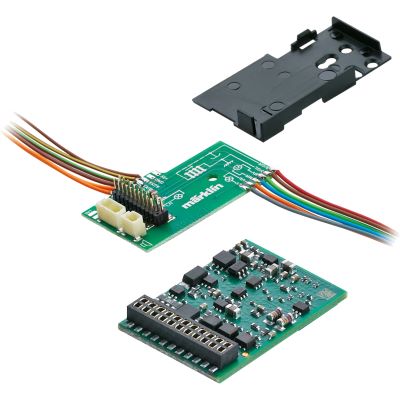
Märklin H0
Märklin 60972 mLD3
Retrofitting decoder for suitable Märklin locomotives and circuit boards.
View ProductH0 Sound and Extensive Vehicle Functions
21MTC Sound Decoders
Sound decoders additionally require a suitable sound project, loudspeaker impedance, installation position and sound enclosure.
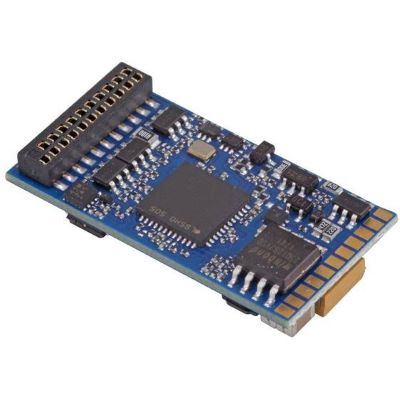
Standard Sound
ESU 58419 LokSound 5
Multiprotocol sound decoder with a standards-compliant 21MTC version.
View Product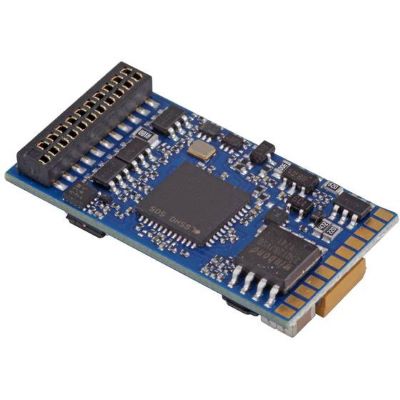
MKL Sound
ESU 58449 LokSound 5 MKL
Sound decoder in the MKL version for correspondingly wired models.
View Product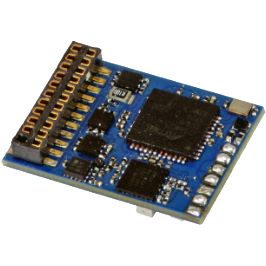
Function Sound
ESU 58219 LokSound 5 Fx
Sound and function decoder for vehicles without their own traction motor.
View Product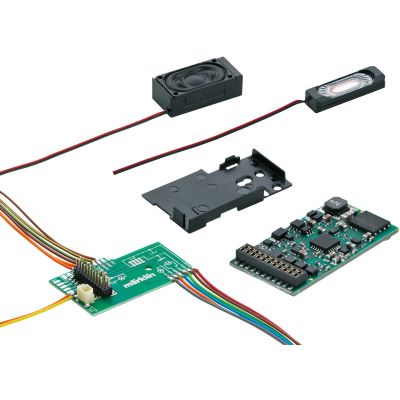
Steam Locomotive
Märklin 60975 mSD3
Retrofitting sound decoder with a prepared steam-locomotive sound project.
View Product
Diesel Locomotive
Märklin 60976 mSD3
Retrofitting sound decoder with a prepared diesel-locomotive sound project.
View Product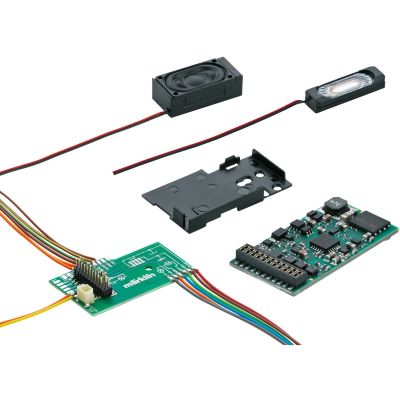
Electric Locomotive
Märklin 60977 mSD3
Retrofitting sound decoder with a prepared electric-locomotive sound project.
View ProductH0 Conversions, Test Benches and Specialist Solutions
21MTC Adapter Boards and Interface Accessories
Adapter boards make wiring easier but do not replace checking the pin assignment. For specialist conversions, the output types, ground connections, motor connections and permitted load must be checked.
Function Outputs
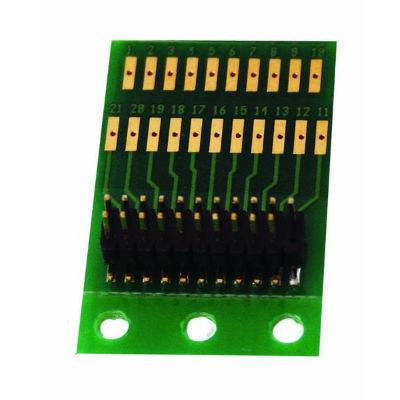
ESU 51957 Adapter Board
Circuit-board solution for eight amplified function outputs.
View Product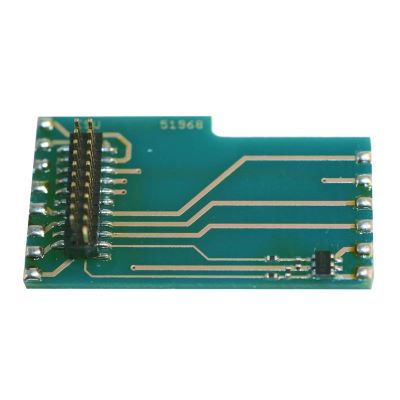
Märklin Conversion
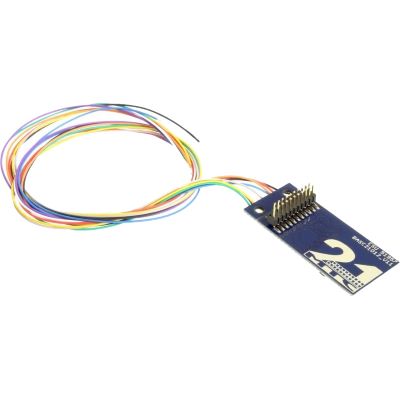
ESU 51968 Adapter Board 2
21MTC board in a 6090x format suitable for conversions.
View Product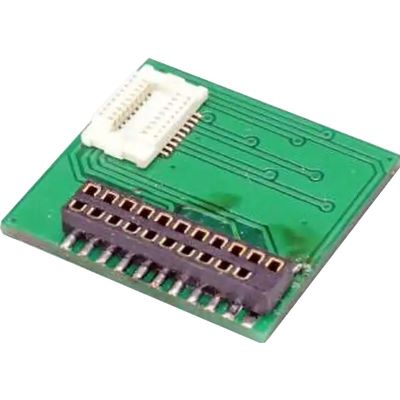
Interface Conversion
ESU 51998 21MTC to Next18
Specialist adapter solution for selected Liliput locomotives.
View Product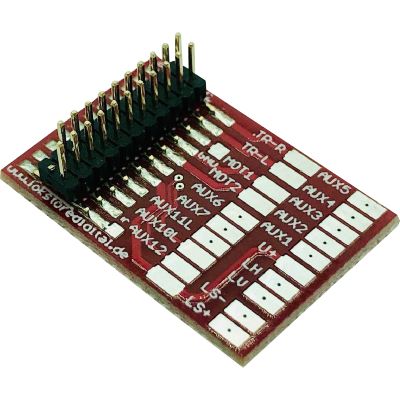
LoDi Adapter
Lokstoredigital LoDi503
21MTC interface board for individual digital conversions.
View Product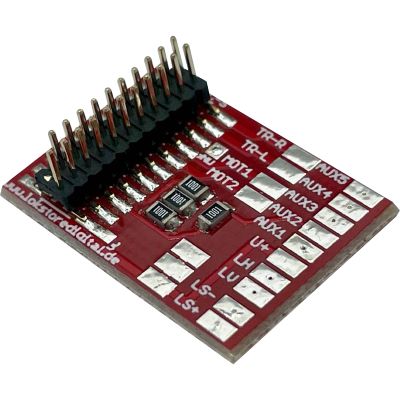
LoDi Specialist
Lokstoredigital LoDi603
Extended 21MTC interface solution for suitable conversion projects.
View Product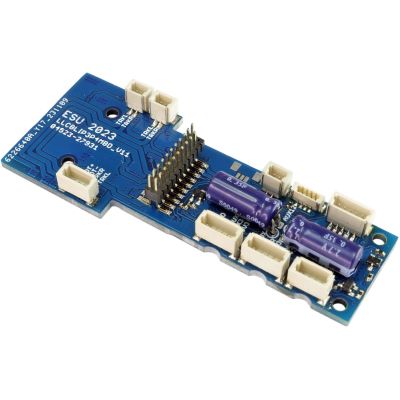
Specialist H0 Conversion
ESU 53952 BLI Adapter
Specialist board for certain BLI steam locomotives with a PowerPack connection.
View Product
Answers before purchase and installation
Frequently Asked Questions about the 21MTC Interface
The following answers provide an initial guide. The technical documents for the vehicle and decoder always remain binding.
Why Is It Called 21MTC When 22 Positions Are Visible?
One of the 22 possible positions is not implemented as an electrical contact. It serves as a mechanical key, leaving 21 contacts that are actually used.
Is 21MTC the Same as DCC or mfx?
No. 21MTC describes the plug-in connection. DCC, Motorola, Selectrix and mfx-compatible formats describe communication between the digital command station and decoder.
Does Every 21MTC Decoder Fit Every 21MTC Locomotive?
Not automatically. The standard or MKL version, motor current, installation space, function outputs, protocols and sound equipment must suit the respective vehicle.
Can 21MTC Be Used in H0 AC and H0 DC?
Yes. The interface is not restricted to centre-contact or two-rail systems. However, the vehicle, motor, current consumption and digital protocol must all be compatible.
Is 21MTC Suitable for Sound Decoders?
Yes. The interface provides loudspeaker contacts and numerous function connections. The loudspeaker, installation space and sound project must also be suitable.
Can a 21MTC Decoder Be Fitted the Wrong Way Round?
The missing contact position assists with orientation. Nevertheless, the pins can be damaged by incorrect positioning or force. Check the installation direction before fitting the decoder.
Why Do AUX3 or AUX4 Not Work After Replacing the Decoder?
The logic levels or amplified outputs frequently do not match the vehicle circuit board. Check whether the model requires the standard or MKL version and whether the function mapping is correct.
Is 21MTC Also Used in Gauges N or TT?
Only rarely. The required decoder space is too large for many N- and TT-gauge vehicles. Next18, NEM 651 and smaller PluX versions are more common in these gauges.
Can the Analogue Blanking Plug Be Reinstalled Later?
Usually yes, provided it has been stored without damage and is specifically intended for the vehicle circuit board. The vehicle must be completely disconnected from the power supply.
Can I Convert 21MTC to Next18 or PluX with an Adapter?
Adapters are available for certain vehicles and applications. However, a mechanical connection does not guarantee a completely compatible electrical assignment or sufficient output capacity.
Which 21MTC Decoder Do I Need for My Locomotive?
Begin with the vehicle manufacturer, article number, standard or MKL version, motor current, digital command station and required functions. You can then narrow down the choice of locomotive, sound or function decoder.
Standards and technical principles
Classifying 21MTC Correctly
The current documents published by model railway associations and manufacturers are decisive for a detailed technical assessment. NEM 660 describes the electrical interface, while RCN-121 provides additional technical guidance for practical implementation.
Product instructions may also specify vehicle-specific circuits, output types and limits. When information conflicts, do not experiment. Obtain an unambiguous approval from the vehicle or decoder manufacturer.
Discover More about Decoder Technology and Digital Model Railways
Explore further explanations covering interfaces, digital command stations, protocols, gauges, layout planning, vehicles and model railway technology in the central guide overview.