H/V · Main signal
Hp 0 · Stop
Stop at the main signal. Under the current rules, this stop aspect applies to both train and shunting movements.
One red light

A main signal indicates whether a train may proceed. A distant signal gives advance information about the next signal aspect. Both DB and DR used semaphore signals; the key differences in colour-light signalling are between H/V, Hl and the later Ks system. Understanding the function first and then reading the signal aspect also helps make these differences clear.
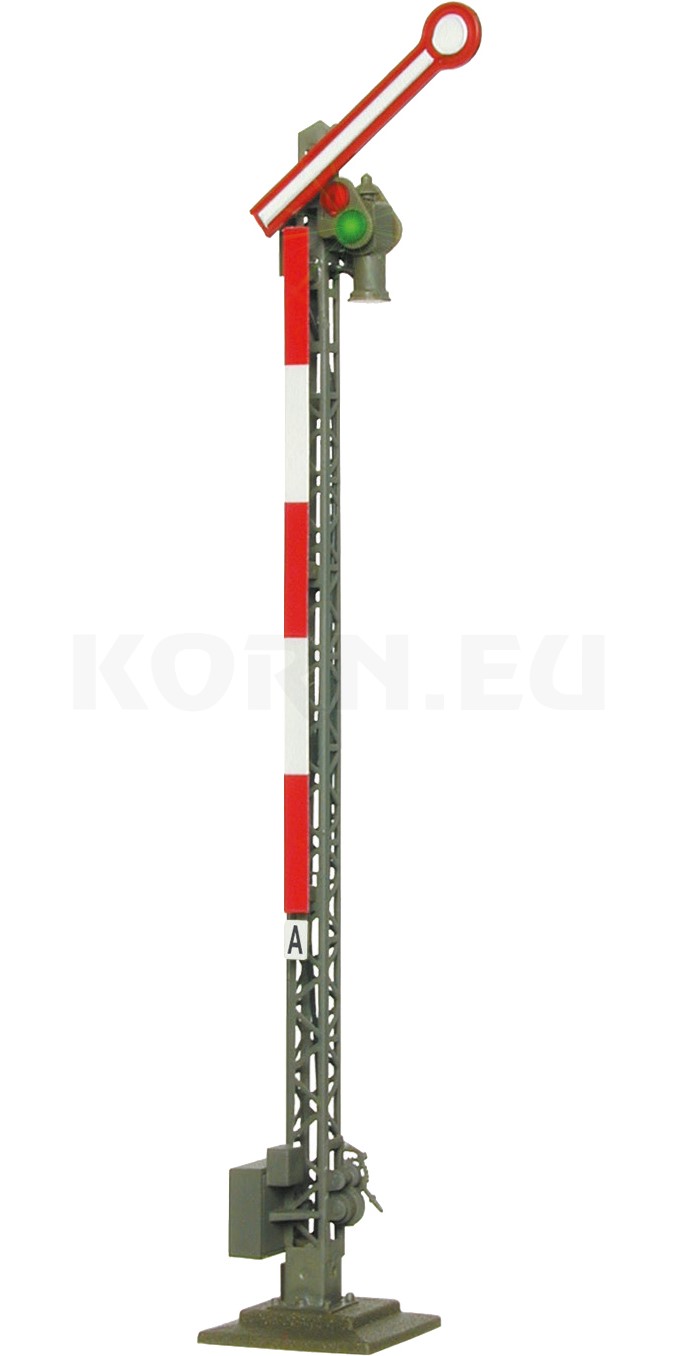 Semaphore signal · MBS166770
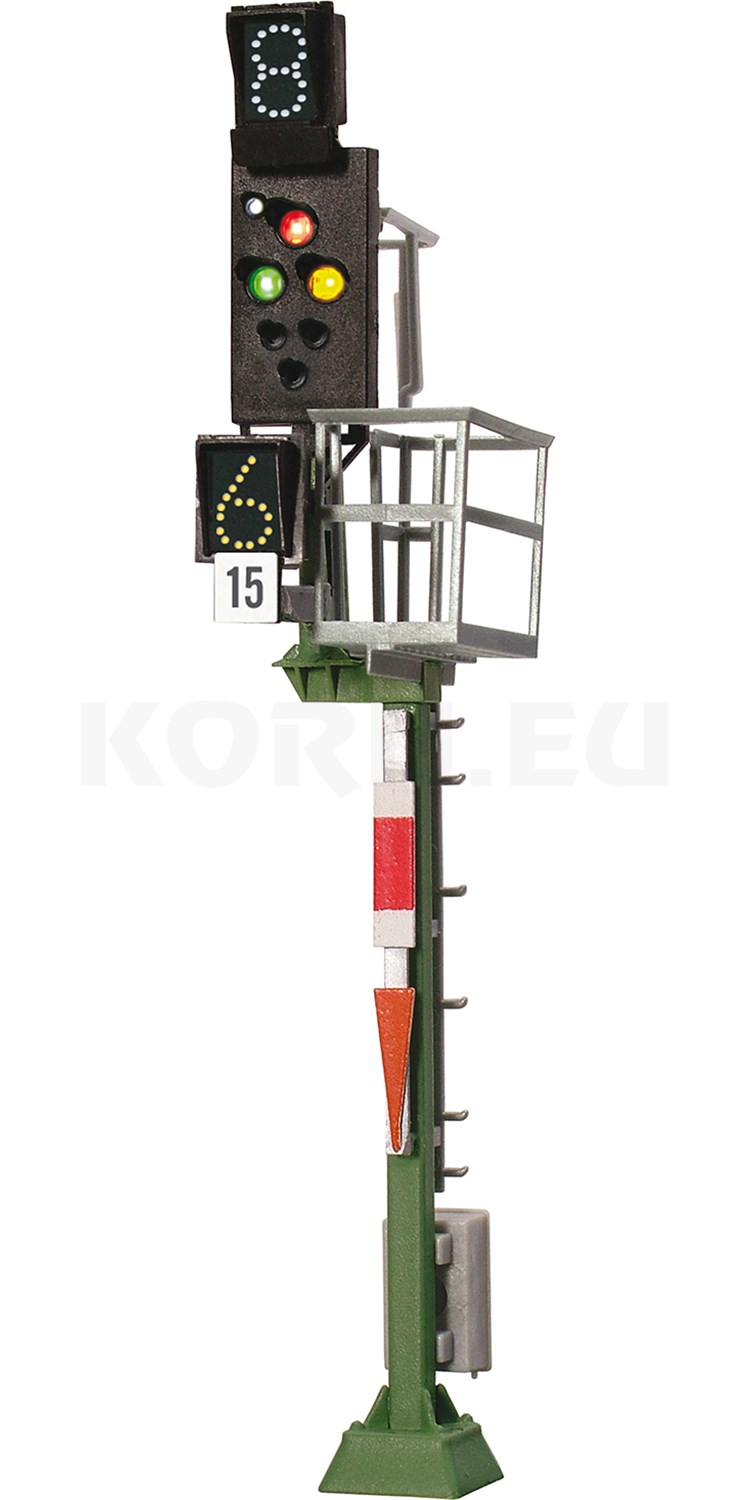 Ks signal · MBS116678
Model semaphore and colour-light signals. Product images illustrate their design; demonstration lamps illuminated simultaneously do not constitute a valid signal aspect.
Imagine a station approach: the train needs advance warning because it cannot be brought to a stand at the last moment before the main signal. The distant signal provides that advance information. The main signal stands at the point where its instruction applies. An entry, exit or block signal is therefore named after its function, while a semaphore signal is named after its design. H/V, Hl and Ks denote different signalling systems. [2]
DB or DR? Here, DB means the former Deutsche Bundesbahn, and DR means the Deutsche Reichsbahn in the GDR. Both became part of Deutsche Bahn AG in 1994. Various signal designs remain in use on today’s DB network. The terminology below follows the current signal rule book; historical DR terms are identified separately. [3]
| Family | Typical setting | What to look for |
|---|---|---|
| Semaphore signals | Bundesbahn and Reichsbahn, including examples retained in later years | Arms, discs and night indications |
| H/V colour-light signals | Many Bundesbahn routes | Read the main and distant signals separately |
| Hl colour-light signals | DR routes and surviving installations in eastern Germany | Now and ahead, steady and flashing lights |
| Ks signals | Routes modernised since the 1990s | Signal function and additional numerals |
This guide helps you choose. For a specific station, the year modelled, photographs and changes to the signalling installation are decisive. [4]
Select an example or display them all side by side. The diagrams simplify the signal designs; the light colours, arrangement and meaning are what matter. Flashing lights are explicitly labelled. These examples provide an introduction, not a complete chart of signal aspects. [1] [2] [5]
All 13 examples are visible.
H/V · Main signal
Hp 0 · Stop
Stop at the main signal. Under the current rules, this stop aspect applies to both train and shunting movements.
One red light
H/V · Main signal
Hp 1 · Proceed
The section ahead may be entered. Other applicable speed limits remain in force.
One green light
H/V · Main signal
Hp 2 · Proceed at reduced speed
Normally 40 km/h from the main signal through the points area immediately beyond it. Observe any authorised indications specifying a different speed.
Green above yellow
H/V · Distant signal
Vr 0 · Expect stop
Prepare to stop at the associated main signal. This distant signal provides the advance warning.
Two yellow lights
H/V · Distant signal
Vr 1 · Expect proceed
Expect a proceed aspect at the associated main signal. Continue to observe the main signal.
Two green lights
H/V · Distant signal
Vr 2 · Expect reduced speed
Expect a speed restriction from the associated main signal.
Yellow, with green above and to the right · DS 301
Hl · Example
Hl 1 · Permitted speed
The otherwise applicable maximum permitted speed may be used. This does not mean unrestricted speed.
Steady green light
Hl · Example
Hl 3a · Initially 40 km/h
Proceed initially at 40 km/h, then resume the otherwise applicable maximum permitted speed in accordance with the rules.
Green above yellow · without a light strip
Hl · Example
Hl 10 · Stop ahead
Reduce speed so that the train can stop before the next main signal.
Steady yellow light
Ks · Main signal example
Ks 1 · Proceed
Proceeding past the main signal is permitted. Also read any supplementary indications and observe other speed limits.
Steady green light
Ks · Example
Ks 2 · Expect stop
Pass the signal and prepare to stop at the next main signal. Yellow here does not mean stop at this signal.
Steady yellow light
Ks · With advance speed indicator
Ks 1 + Zs 3v · Expect 60 km/h
The green light flashes. The yellow numeral 6 gives advance warning of a speed indicator for 60 km/h.
Flashing green light + yellow 6
Shunting · Colour-light signal
Sh 1 / Ra 12 · Shunting movement
Two white lights: Sh 1 in the DS 301 area, Ra 12 in the DV 301 area. This is not normal authority for a train movement.
Two white lights rising to the right
Vr 2 is shown here in the usual DS 301 arrangement. In the DV 301 area, the colour arrangement may be reversed.
H/V separates two questions: what applies here, and what should be expected at the next main signal? This is why a green main signal can be combined with a yellow distant signal on the same post. The train may proceed but must prepare to stop at the following main signal. The distant signal below does not refer to the main signal immediately above it. When that main signal shows stop, the colour-light distant signal below remains dark. [1]
Hp 2 indicates a speed restriction, normally 40 km/h; any authorised indications specifying a different speed must be observed. The restriction applies from the main signal through the points area immediately beyond it. It is not a universal instruction meaning “points set to diverge”. The permitted speed of a route and its operating conditions also matter. Likewise, the green light of Hp 1 does not cancel other speed limits.
On a semaphore main signal, a horizontal upper arm means stop. If it points diagonally upwards to the right, the signal indicates proceed. Two arms pointing upwards to the right indicate proceed at reduced speed. The corresponding lights help identify the aspect in darkness. A two-arm model may display two or three aspects: Coupled arms usually provide Hp 0/Hp 2; for Hp 0/Hp 1/Hp 2, you need the version designed for those aspects. [6]
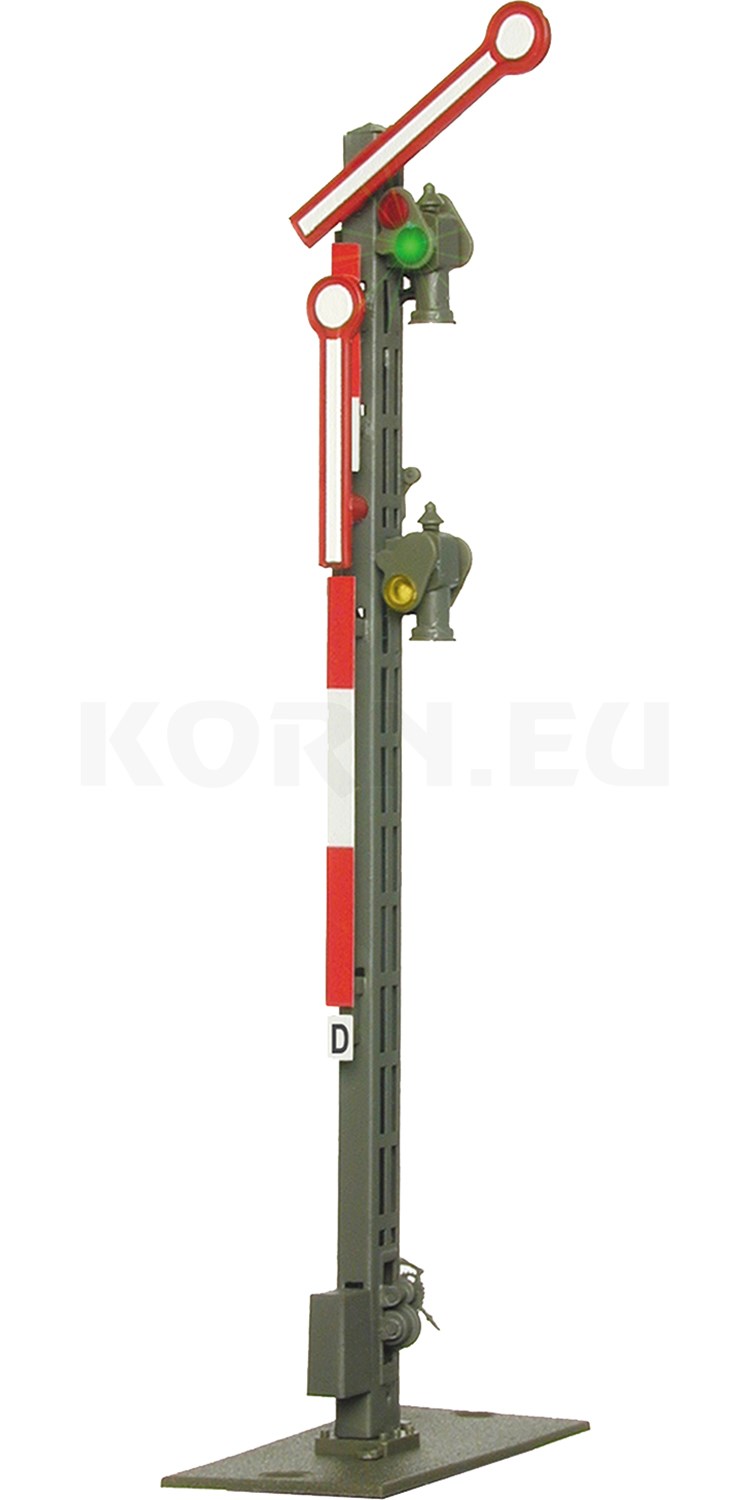
Three aspects on a semaphore main signal
Viessmann 4532: Hp 0, Hp 1 and Hp 2 with two independently operated arms.
H0 gauge · MBS item number MBS102921
View model in the shop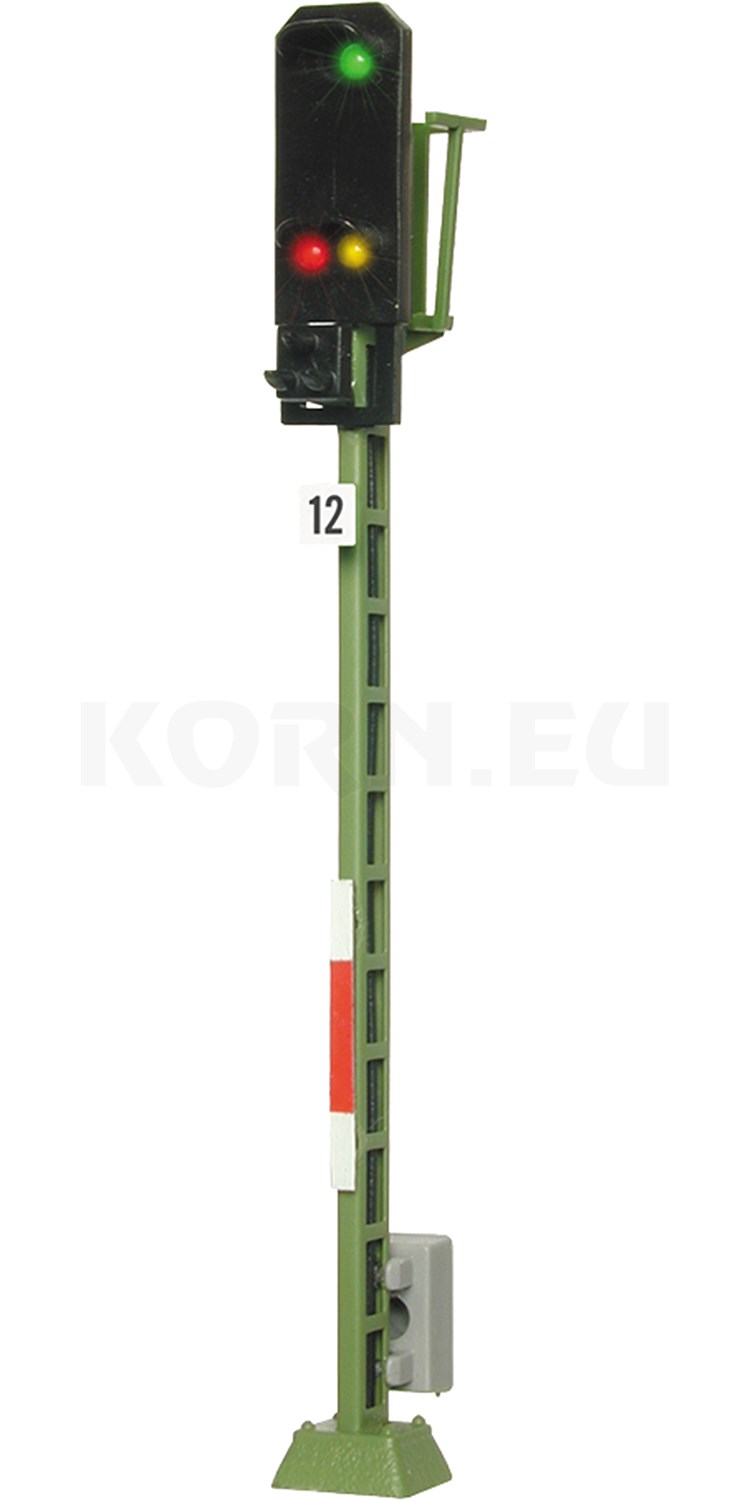
An H/V colour-light signal in model form
Viessmann 4012. Product image illustrating the design; not a valid signal aspect.
H0 gauge · MBS item number MBS105322
View model in the shopThe Hl system combines speed information. In an aspect with two lights, the lower light refers to the speed from the main signal, while the upper light gives advance information about the situation at the next main signal. Additional light strips change the indicated speed: together with the lower yellow light, a yellow strip means 60 km/h and a green strip means 100 km/h. Not every signal head has all the lamps and strips. [5]
Hl 10 is particularly easy to confuse: A steady yellow light warns of a stop ahead. With Hl 3a, the lower yellow light initially means 40 km/h from the main signal and through the points area immediately beyond it. The upper green light indicates that the otherwise applicable maximum permitted speed can be expected at the next main signal. The train must therefore not simply accelerate immediately after passing the post.
Semaphore signals are also appropriate for the Reichsbahn. One special case is Vr 1/2 (DV 301): on two-aspect semaphore distant signals, it indicates expect proceed or expect reduced speed. A green night indication there does not therefore unambiguously indicate that Hp 1 is to be expected. Historical DR documents from 1971 also use Hf/Vf for semaphore signals and Hl 13 for the red Hl stop aspect; today, that stop aspect is called Hp 0. [1] [7]
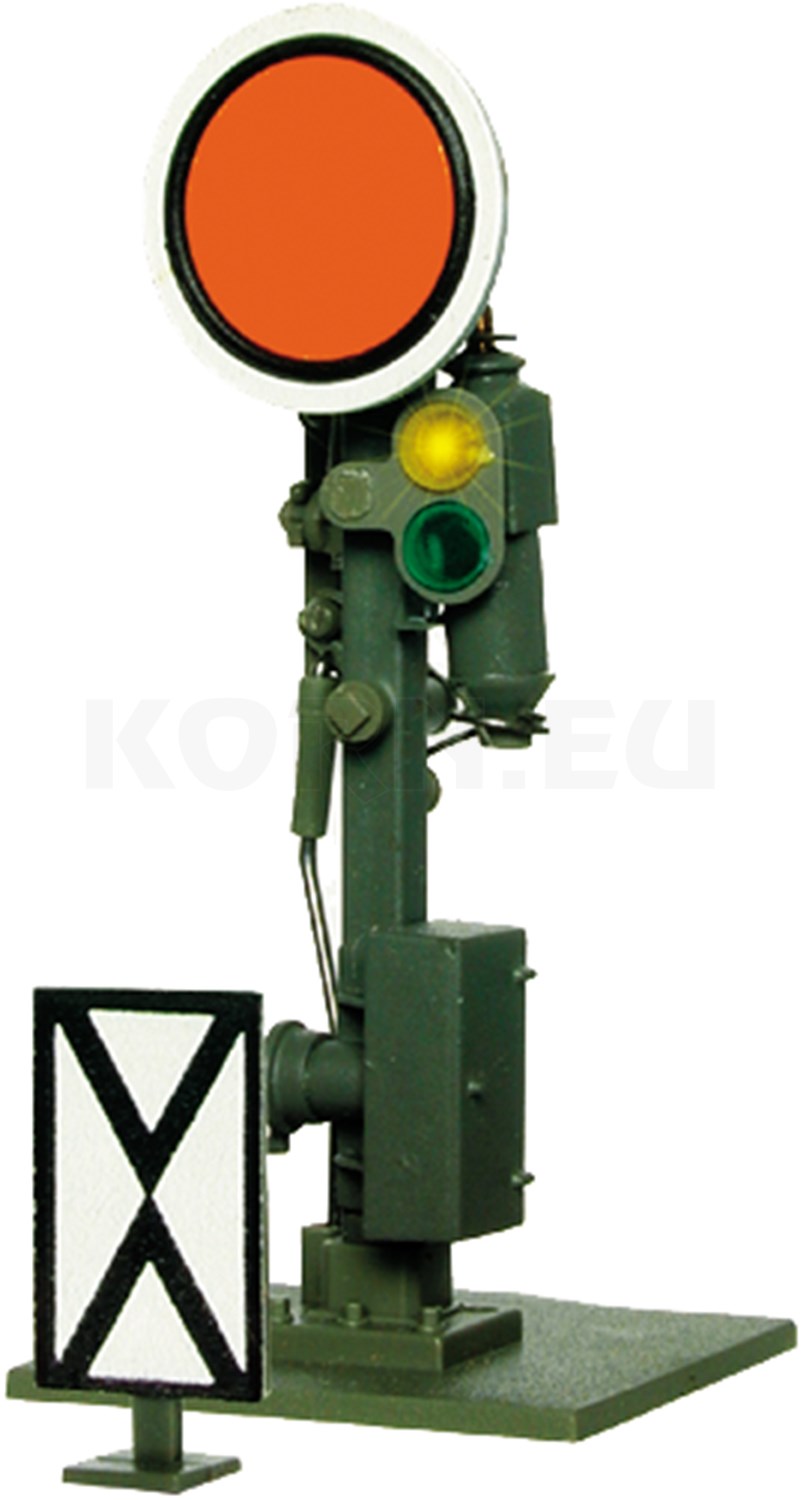
A DR semaphore distant signal in TT
Viessmann 4906: a specific signal design for a DR layout. Distinguish carefully between historical distant-signal meanings and model designations.
TT gauge · MBS item number MBS102953
View model in the shopKs signals can perform a main-signal function, a distant-signal function or both. A green Ks 1 must therefore be interpreted together with the signal’s function. The yellow Ks 2 gives advance warning of a stop; it does not prohibit passing the signal. A red Hp 0, by contrast, requires a stop. Choosing a model therefore involves more than the shape of the signal head. [4]
White numeral: Zs 3. The speed indicator gives the speed in tens of kilometres per hour: a 6 means 60 km/h. Yellow numeral: Zs 3v. The advance indicator gives warning of such a restriction. With Ks 1 and Zs 3v, the green light flashes. This differs from the flashing green Hl 4 aspect, which announces a reduction to 100 km/h. The signalling system and supplementary indication are always part of the message. [1]
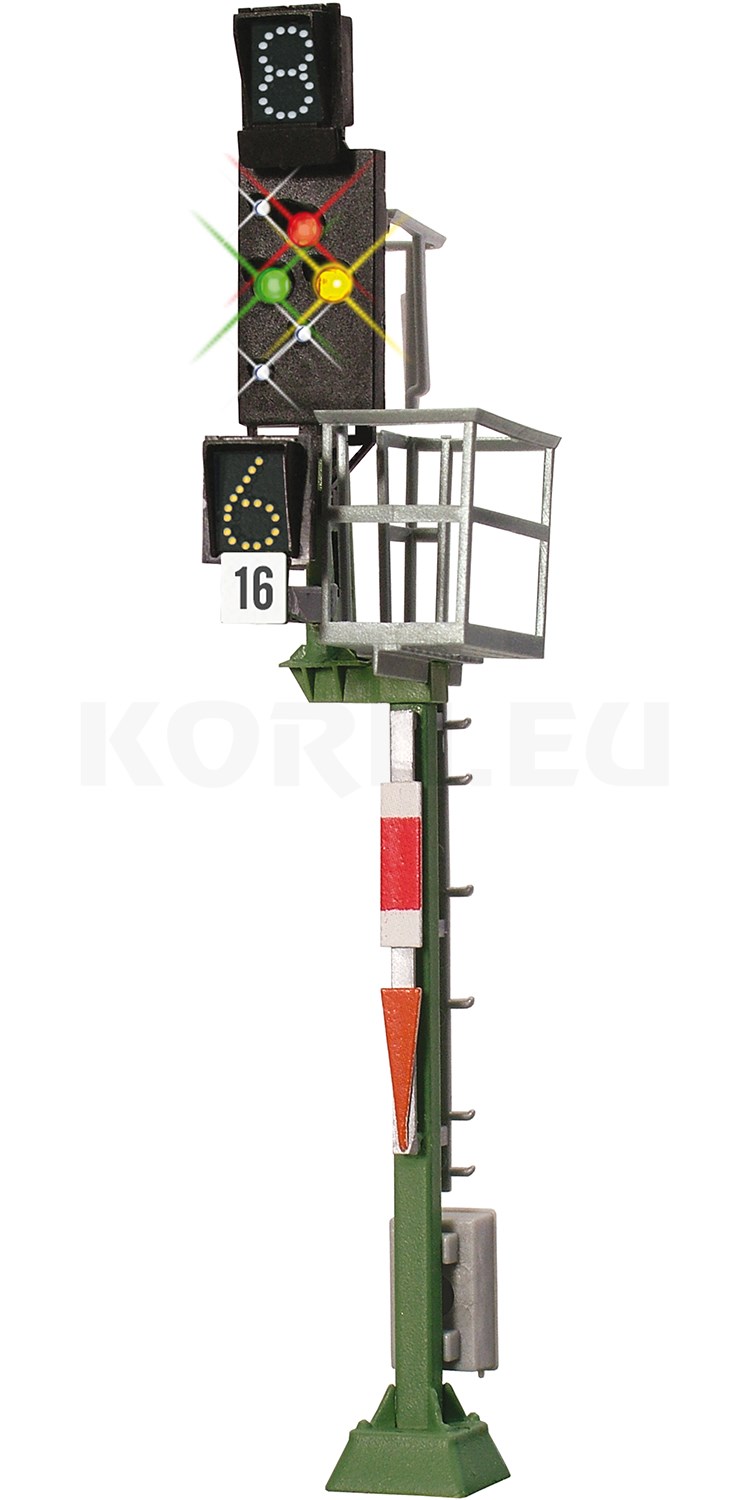
A Ks multi-section signal in H0
Viessmann 4046 with main- and distant-signal functions. Product image illustrating the design; not a valid signal aspect.
H0 gauge · MBS item number MBS116679
View model in the shop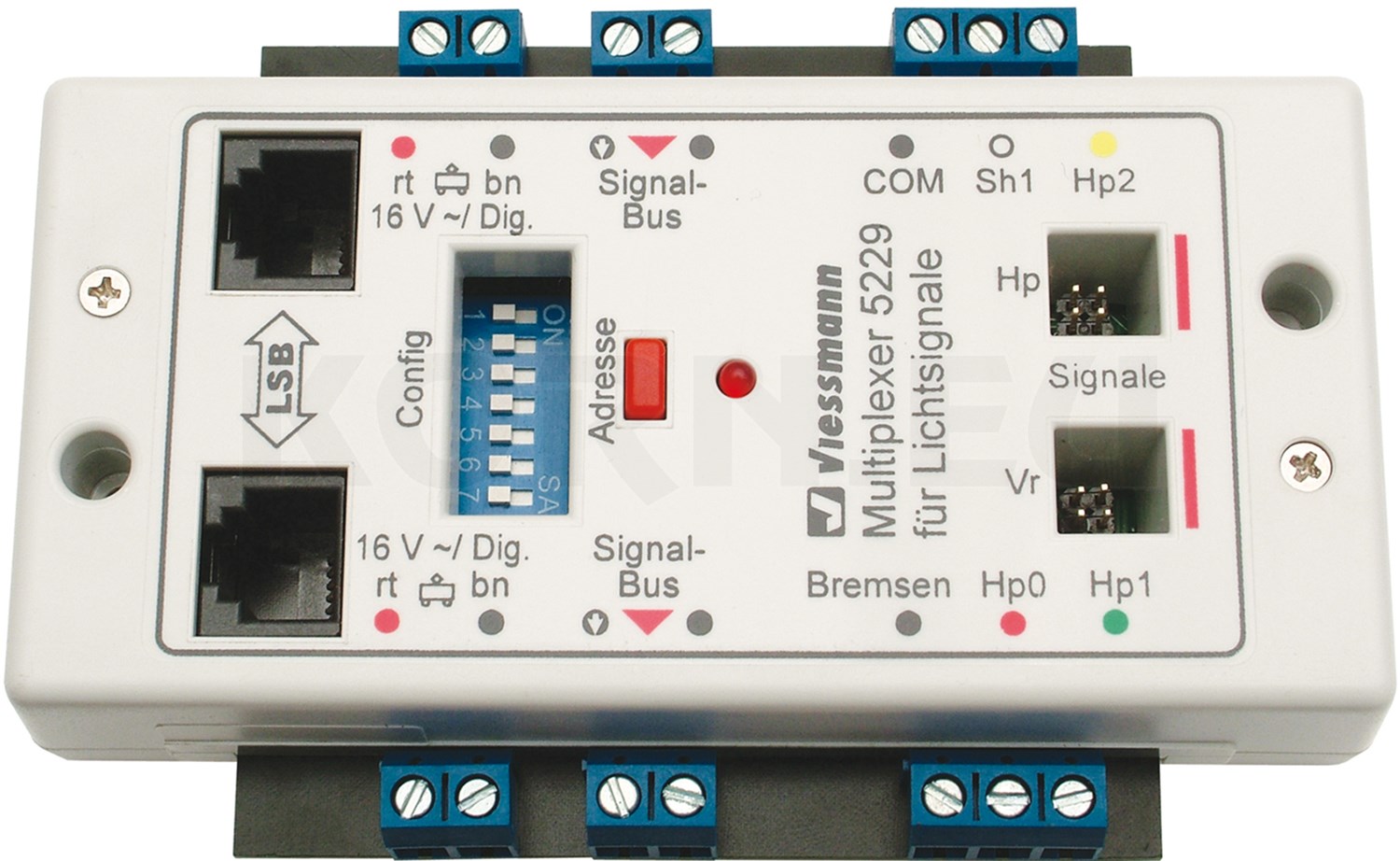
Control equipment to match the signalling technology
Viessmann 5229 for compatible Multiplex colour-light signals. Use the instructions to choose the functions you need.
All gauges · MBS item number MBS127015
View model in the shopFor operating purposes, train movements and shunting movements are distinct. Two white lights rising to the right form the colour-light aspect Sh 1 in the DS 301 area or Ra 12 in the DV 301 area. They concern shunting movements and are not normal authority for a train movement. If displayed together with Hp 0, they must not be interpreted as “proceed for everyone”. [1]
Ra 10 marks the limit beyond which shunting movements do not normally proceed. Sh 2 is the protective stop signal, shown by day as a rectangular red board with a white border. It is suitable, for example, for a closed section of track. A round mechanical shunting signal is a different design. A derail indicator showing Sh 1 does not replace the required permission to shunt.
Read the designation together with its area: In the DS 301 area, Ra 12 denotes the fouling point marker. The “DV 301” designation is therefore part of the explanation of the DR shunting light signal.
Our planning example is a station with two tracks and H/V signalling. Track 1 is the through main track, while track 2 allows trains travelling in opposite directions to pass. For a diverging entry, we assume a route with a permitted speed of 40 km/h. This assumption defines the example; it does not automatically apply to every station.
Apply this logic to the track plan first. On the prototype, distant-signal spacing is based on braking distance. As a numerical example, 1,000 metres would be approximately 11.49 metres in H0, 8.33 metres in TT and 6.25 metres in N. Deliberate shortening therefore makes sense on small layouts; the sequence and a clear relationship between signals remain more important than an arbitrary uniform distance in centimetres.
Plan signal aspects and train control separately: A red LED does not stop the locomotive by itself. Feedback, control and the chosen braking solution must work together. Useful guides cover track occupancy detection and model railway software (German guide).
First choose the prototype and the signal aspects you need, then the gauge. H0, TT, N and G require appropriately sized models; gauge alone does not determine electrical compatibility. For LED signals, relevant factors include the type of connection, series resistors and decoder. Viessmann Multiplex signals require the modules designed for them. For other signals, refer to their respective instructions. [4] [5]
The search filters products that have been loaded; searching further shop pages adds more products. Product photographs show models and may have several lights illuminated for demonstration purposes.
Use the category links to find suitable items.
Manufacturers in our range

No. Ks 2 and Hl 10 announce a stop ahead. Hp 2 combines green and yellow to indicate reduced-speed running. The meaning depends on the signalling system, the complete aspect and any supplementary indications.
Yes, if there is a credible basis for it in your chosen prototype. Decide on the year and region, then find photographs of the location. A mixture should reflect the history of the railway you are modelling.
Ks signals are not suitable for this particular historical setting. Check which semaphore or Hl signals were used at the location. Ks signals represent a later development from the 1990s onwards.
A signal acting only as a distant signal provides advance information. It does not replace a main signal. Even when both are mounted on the same post, you must distinguish between their two functions.
No. The protocol, connection type and supported signal aspects must be compatible. A simple switching output does not automatically provide flashing Hl aspects, Multiplex connections or control of train movements.
Start with the movements you actually operate. A coherent entry route, suitable exit routes and a shunting area offer more operational interest than signal masts placed randomly before every set of points.
Sources checked: 24 November 2026. A simplified introduction for railway modellers; local variations and the full operating rules are covered in the original documents.
Explore your prototype theme in more detail, plan your control system and find signals for your layout.
Prototype & Era
Operation & Control
Planning signals and routes for your model railway? Stay connected with Modellbahnshop and choose the WhatsApp channel for your gauge.
WhatsApp: your gauge, your channel
New products and relevant model railway updates by gauge: open the channel and follow it in WhatsApp.
Choose the channels that suit you. If you model more than one gauge, you can follow several channels.